
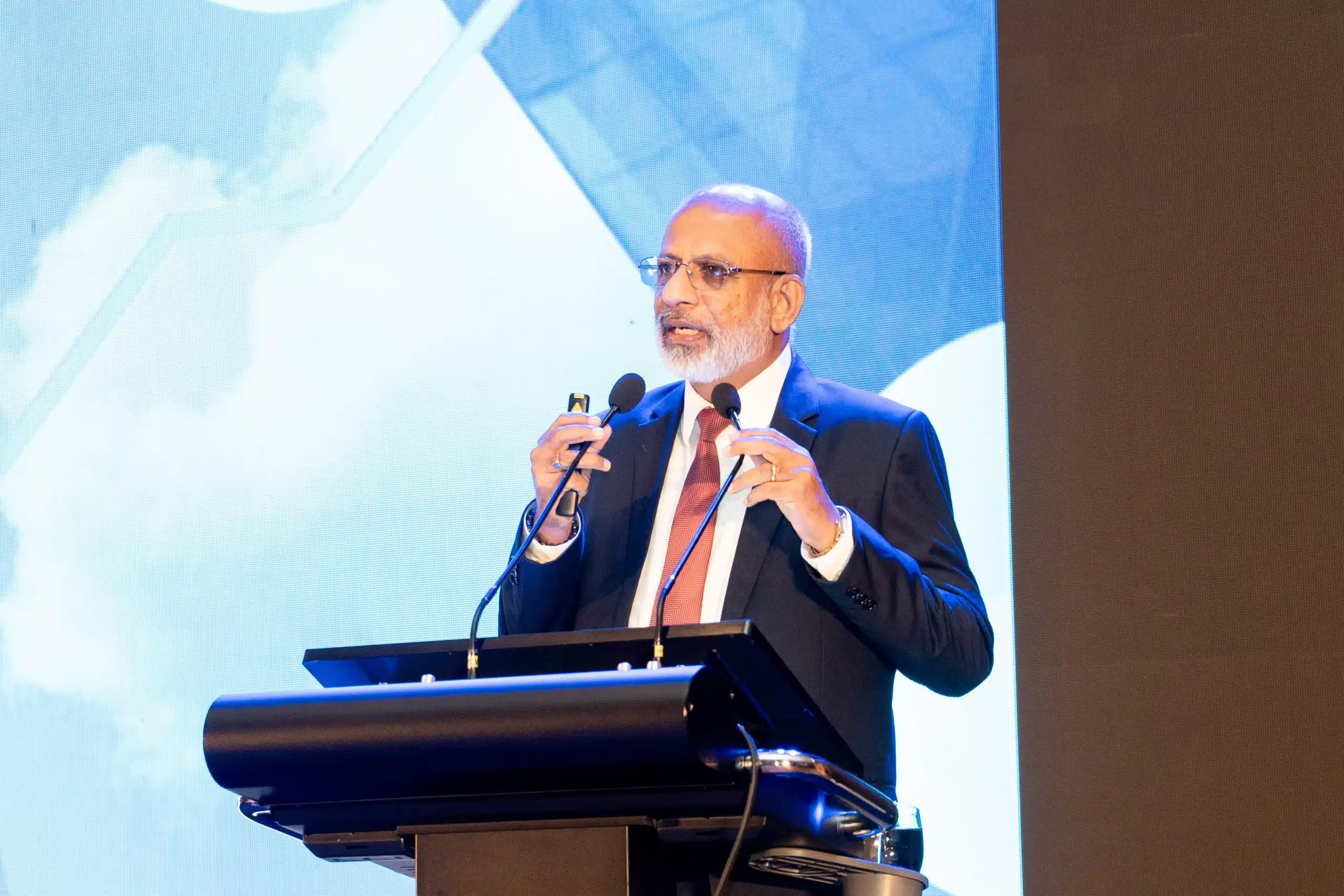
Sri Lanka capital market development must become a central component of the country’s transition from economic recovery to sustainable growth, Securities and Exchange Commission (SEC) Chairman Senior Professor Hareendra Dissabandara said at the Capital Market Industry Forum held on 27 October 2026.
Delivering an address titled “From Resilience to Sustainable Growth: The Future of Sri Lanka’s Capital Market,” he emphasised that although the country has made progress in restoring economic stability following its unprecedented financial crisis, the next challenge is to translate that recovery into higher productivity, investment and long-term prosperity. He also outlined the SEC’s capital market development strategy, the need for greater policy recognition and the importance of maintaining investor confidence during periods of market uncertainty.
Sri Lanka Capital Market Must Support the Transition from Recovery to Growth
Professor Dissabandara identified three distinct stages in Sri Lanka’s recent economic journey – rescue, recovery and sustainable growth. He observed that debt restructuring, the International Monetary Fund-supported programme and fiscal and monetary reforms had helped establish a foundation for economic stabilisation.
However, he cautioned against treating economic recovery as the final objective. While the rescue phase has largely served its immediate purpose, maintaining macroeconomic stability and completing necessary reforms remain important. He stressed that the country must now focus on developing productive capacity, attracting investment, creating employment and strengthening competitive enterprises rather than remaining dependent on external financial assistance.
SEC Chairman Calls for Higher Growth Supported by Productive Investment
Referring to Sri Lanka’s recent economic growth of approximately 4-5%, Professor Dissabandara said the improvement was encouraging given the severity of the country’s financial crisis. Nevertheless, he argued that this level of growth would be insufficient to meet Sri Lanka’s long-term development aspirations and that the country should aim for sustained growth of 7-9%, supported by improvements in productivity, competitiveness and investment.
He emphasised that achieving higher growth would require identifying the additional investment needed, the sectors capable of generating stronger economic returns and suitable financing mechanisms. While Government borrowing and commercial bank lending remain important, he said they should not be expected to meet every long-term financing requirement. Equity markets, corporate debt instruments and collective investment schemes could provide alternative sources of capital for productive business activity.
Greater Recognition of Capital Market Development in the National Budget
The SEC Chairman called on the Government to recognise the role of Sri Lanka’s capital market in the forthcoming National Budget and the wider national economic development agenda. He noted that the SEC and Colombo Stock Exchange had identified proposals intended to strengthen the market’s ability to mobilise investment.
These measures include encouraging companies to raise capital, supporting new stock market listings, introducing suitable financial instruments, attracting long-term institutional investors and expanding public participation. He also suggested that suitable State-owned enterprises could be considered for capital market participation, provided such initiatives were consistent with Government policy, commercial viability, public interest and appropriate governance arrangements. He stressed that predictable economic policies and institutional credibility were essential to securing long-term investment.
SEC’s 12-Pillar Strategy Targets a More Resilient Capital Market
Outlining the SEC’s Capital Market Strategy for 2025–2035, Professor Dissabandara presented the initiative titled “12 Pillars – One Vision for a Resilient Market.” The strategy comprises twelve interconnected projects intended to strengthen Sri Lanka’s capital market through regulatory improvements, institutional development, technological advancement and broader investment participation.
The reform agenda includes developing the corporate debt market, introducing new investment products, expanding collective investment schemes, encouraging new listings and attracting domestic and foreign investment funds. It also covers the demutualisation of the Colombo Stock Exchange, the establishment of a Central Counterparty mechanism and the development of a multi-asset-class derivatives exchange. Investor education, research, training, digital transformation, regulatory improvements and stronger risk management are additional priorities. He noted that some initiatives could deliver results relatively quickly, while others would require further institutional, legislative and technological development.
Long-Term Stock Market Performance Must Be Evaluated Alongside Risk
Discussing the historical performance of Sri Lanka’s stock market, Professor Dissabandara referred to an analysis of the All Share Price Index covering the period from 1985 to October 2026. He explained that although the market had experienced considerable volatility during periods of economic and political uncertainty, its longer-term history also demonstrated substantial growth and recovery.
He emphasised that historical investment returns should not be interpreted as a guarantee of future performance. Investors must assess market volatility, dividend income, inflation, investment horizons and the financial strength of individual companies. Comparisons between equities and bank deposits should also account for differences in risk and the effect of compounding. Financial literacy, diversification and sound professional advice, he said, remained essential to making informed investment decisions.
Recent Colombo Stock Exchange Decline Requires Objective Assessment
Addressing concerns about the recent decline in Colombo Stock Exchange prices, the SEC Chairman attributed market pressures to a combination of domestic and international developments. These included geopolitical tensions in the Middle East, higher international energy prices, foreign portfolio adjustments, interest-rate movements, inflation, exchange-rate changes, profit-taking and periods of relatively low market liquidity.
He cautioned that declining share prices should not automatically be interpreted as evidence of financial weakness across all listed companies. Some businesses continued to demonstrate strong balance sheets and positive earnings prospects. He also highlighted the importance of distinguishing foreign portfolio outflows from equities from broader capital movements, noting that Sri Lanka had recorded foreign investment inflows into Government securities. Investors were urged to consider company fundamentals and reliable information rather than reacting to speculation or short-term market movements.
Market Integrity and Professional Ethics Remain Essential
Professor Dissabandara warned that periods of low market liquidity could increase the potential impact of misleading transactions, artificial price movements and market manipulation. He emphasised that legitimate market fluctuations and price declines should not themselves be treated as evidence of misconduct, but reiterated the SEC’s commitment to maintaining market integrity and addressing prohibited practices.
He also stressed that professional ethics must extend beyond regulatory compliance. Stockbrokers, investment advisers, fund managers and other market intermediaries have a responsibility to provide accurate information, explain investment risks and help clients make decisions suited to their financial circumstances. He urged industry professionals to maintain their knowledge of economic developments, financial products, market regulations and emerging risks, noting that investor confidence must be earned through competence, transparency and professional integrity.
Building a Future-Ready Capital Market for Sustainable Growth
Looking ahead, the SEC Chairman highlighted the need for Sri Lanka’s capital market to prepare for changing investor expectations and technological developments. Future generations will increasingly interact with artificial intelligence, digital financial services, automated platforms and advanced financial products. He said market institutions must respond through improved digital accessibility, cybersecurity, data protection and responsible innovation while maintaining strong investor safeguards.
Concluding his address, Professor Dissabandara called for collective action from policymakers, businesses, investors, market intermediaries, the SEC and the Colombo Stock Exchange to strengthen long-term capital formation. He emphasised that the objective should extend beyond increasing stock market indices to developing a capital market capable of financing productive enterprises and generating lasting economic value.
“Recovery creates stability. Stability creates the conditions for investment. Investment creates productive capacity. And productive investment, supported by confidence and good governance, is the foundation of sustainable growth,” he stated.
He concluded that Sri Lanka must work towards building a resilient, trustworthy and future-ready capital market that makes a meaningful contribution to the country’s sustainable economic growth.
Editorial Note: This report is based on the address delivered by Senior Professor Hareendra Dissabandara, Chairman of the Securities and Exchange Commission of Sri Lanka, at the Capital Market Industry Forum on 27 October 2026, titled “From Resilience to Sustainable Growth: The Future of Sri Lanka’s Capital Market.” Growth aspirations, market assessments and policy proposals are presented as expressed in the address.