
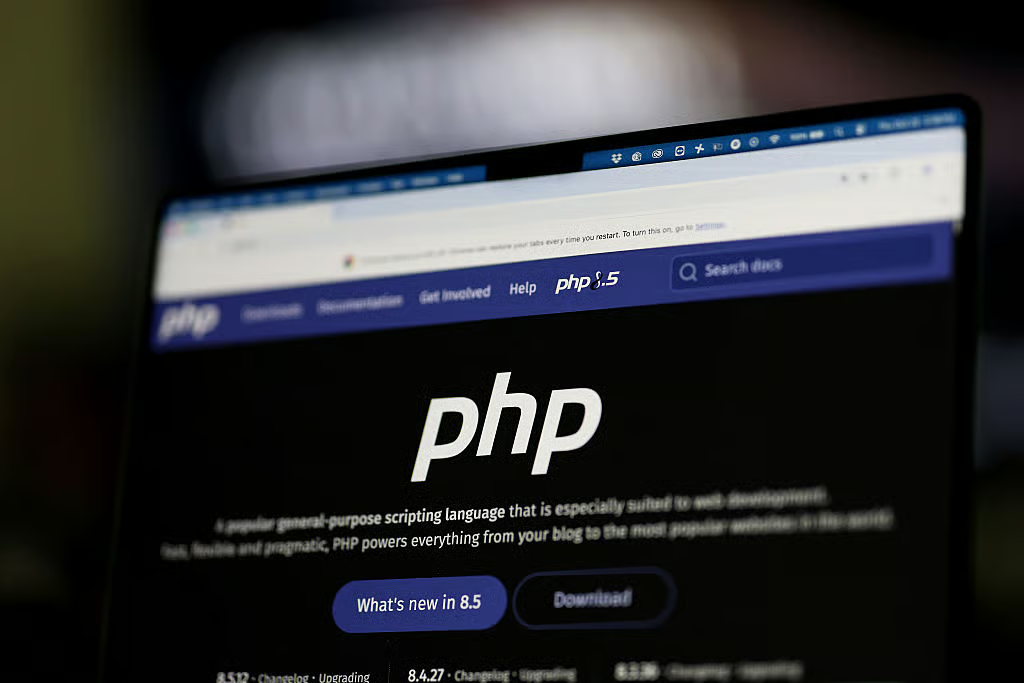
A routine visit to a website rarely reveals what is happening behind the screen. Whether someone is checking a bank account, shopping online, accessing government services or reading the news, thousands of lines of software work quietly in the background. This week, weaknesses in one of the internet’s most widely used programming languages brought that usually invisible infrastructure into the spotlight, prompting emergency security updates and temporary website shutdowns across several countries.
The problem, known as the PHP2Shell vulnerability, involves two critical weaknesses in PHP, the programming language that supports nearly 70% of websites worldwide. On 21 October, the PHP development team released emergency updates after researchers identified flaws that could allow attackers to execute malicious commands on vulnerable servers without first logging in. Both vulnerabilities received a critical severity score of 9.2 out of 10 under the CVSS 4.0 framework.
By 23 October, the situation had become more complicated. Amazon had reported attempted exploitation dating back to 17 October, while the PHP team issued a fresh advisory concerning an additional, less common security issue. The immediate danger is real, but it is important to understand that websites temporarily going offline for protection is not the same as attackers successfully taking control of them.
Check The Latest | AI Agents Accessing Bank Accounts: Did They Really Go Rogue?
PHP2Shell Vulnerability: Why Is This Such a Serious Problem?
PHP is a programming language used by web servers to perform tasks that visitors rarely see. It helps websites retrieve information, process forms, manage customer sessions and deliver dynamic content. Popular platforms including WordPress, Drupal and Magento use PHP, making the technology important to businesses ranging from small online shops to large organisations.
The newly discovered vulnerabilities, identified as CVE-2026-109618 and CVE-2026-109619, concern how PHP manages computer memory when processing requests. Under particular conditions, an attacker can manipulate that process, potentially causing the server to run unauthorised code or expose sensitive information.
This is why the problem is considerably more serious than an ordinary website error. Successful exploitation could potentially give an attacker access to information or functions that should remain protected. The level of damage would depend on the affected server, its configuration and the permissions available to the PHP process.
The official PHP security announcement identifies installations using Apache, PHP-FPM, php-cgi, FrankenPHP and LiteSpeed among those requiring attention, with Apache’s mod_php configuration assessed as particularly exposed.
How Did a Software Vulnerability Become a Global Emergency?
The security disclosure arrived earlier than originally planned after technical information became public ahead of the coordinated release. The PHP team responded by making emergency fixes available on 21 October, while cybersecurity companies and hosting providers began deploying additional protections.
The concern was not limited to theoretical attacks. Amazon Threat Intelligence reported detecting an attempted exploit on 17 October, four days before the public disclosure. Additional attempts were identified around the release period, followed by broader activity targeting systems monitored by Amazon.
Meanwhile, Cloudflare reported detecting attack traffic and deployed protective firewall rules for customers. The company also explained that attackers were modifying their requests in attempts to bypass security controls, demonstrating why simply knowing that a vulnerability exists is not enough to prevent exploitation.
However, attempts detected by security systems should not automatically be counted as successful breaches. Testing environments and protective services can detect malicious requests without the targeted organisation actually being compromised.
Why Did Government and Business Websites Go Offline?
The disclosure prompted precautionary shutdowns because some organisations needed time to install updates and assess whether their systems remained exposed.
Government agencies and businesses in Europe and Asia temporarily suspended selected online services while technical teams applied security fixes. In Japan, affected services included government websites and systems operated by major financial, transport and communications organisations.
On 23 October, Japan also announced plans to strengthen AI-assisted cybersecurity testing. The decision followed the wider international response to the PHP vulnerabilities and reflects growing concern about how quickly attackers can identify and target weaknesses in essential digital infrastructure.
These developments should not be interpreted as evidence of a global internet collapse. The shutdowns largely involved individual organisations taking protective measures, and the available reporting does not establish that every interrupted service had been successfully attacked.
The Latest Development: A New Warning on 23 October
The most recent update comes directly from the PHP development team.
On 23 October 2026, PHP published an additional advisory concerning a rare remote-code-execution risk involving session upload progress. The team has assigned the issue CVE-2026-115560 and intends to address it through a subsequent regular bug-fix release.
The issue requires an unusual combination of application configuration and runtime behaviour, meaning it is not necessarily a vulnerability affecting every website in the same way. Nevertheless, PHP has advised administrators to temporarily disable the session.upload_progress feature where appropriate until the next fix is released.
This is a separate development from the two critical vulnerabilities addressed by the emergency updates on 21 October. It demonstrates why cybersecurity work does not necessarily end when the first patch becomes available, particularly while researchers continue examining related behaviour.
What Should Website Owners Do Now?
The PHP project has released patched versions 8.5.12, 8.4.27, 8.3.36 and 8.2.35. Website administrators should ensure their systems are running the relevant patched release or a vendor-maintained version containing the equivalent security fixes.
For businesses using WordPress, updating themes and plugins alone will not resolve these particular vulnerabilities because the weaknesses exist in the PHP software running on the server. Website owners using shared hosting should therefore contact their hosting provider and confirm that the underlying PHP installation has been secured.
There is an important distinction for managed services. WordPress.com has confirmed that websites hosted on its own managed platform are already protected. However, independently hosted WordPress websites should verify their own provider’s security status rather than assuming that every WordPress installation automatically received the same protection.
Businesses should also review server activity for suspicious requests or unexpected file changes. Firewall protection provides an additional safeguard, but the PHP development team and major cybersecurity providers emphasise that applying the correct server-level fixes remains essential.
Why Sri Lankan Businesses Should Pay Attention
There is no verified evidence in the sources reviewed for this article that a Sri Lankan banking institution, government website or major commercial platform has been compromised specifically through PHP2Shell.
Nevertheless, the vulnerability is globally relevant because Sri Lankan businesses rely on the same website technologies used internationally. Online stores, booking platforms, educational portals, news websites and customer-service applications may depend on PHP without their owners having direct knowledge of the installed version.
A security incident could interrupt online sales, disrupt customer access or expose information, depending on the compromised system. This makes website maintenance a business-continuity responsibility rather than merely a technical task delegated to a developer.
For companies using external web-development agencies, the immediate priority is obtaining confirmation that the hosting environment has been checked and the relevant security updates applied. Businesses should also maintain reliable backups, review access permissions and ensure that critical software is updated through a documented maintenance process.
Check The Latest | Recursive Self-Improvement AI Risk: Why Business Leaders Are Paying Attention
The Bigger Lesson Behind the PHP Security Emergency
The PHP2Shell incident illustrates how much of the global digital economy depends on software that ordinary users never encounter directly. A weakness deep inside a widely used programming language can affect organisations across different countries and industries, even when their websites serve completely unrelated purposes.
Artificial intelligence adds another dimension to this challenge. AI-assisted research contributed to identifying the vulnerabilities, while security specialists are increasingly concerned that similar tools can help attackers analyse publicly disclosed weaknesses and develop exploitation methods faster.
The solution is not to avoid the technologies on which modern websites depend. It is to recognise that software security requires continuous maintenance, rapid communication between developers and hosting providers, and the ability to respond before a vulnerability becomes a serious incident.
For Sri Lankan businesses, the immediate message is practical: check the PHP security status of your website, confirm that the latest applicable fixes are installed and do not assume that updating website content or plugins is enough.
The international response has shown how quickly a software vulnerability can become a business problem. The companies that maintain their digital systems properly are better positioned to prevent a security warning from becoming an operational crisis.
This article is intended for educational, technology and business-awareness purposes. Security advisories and remediation guidance reflect information available as of 23 October 2026. The discovery of attempted exploitation does not necessarily indicate a successful breach of the targeted system.