
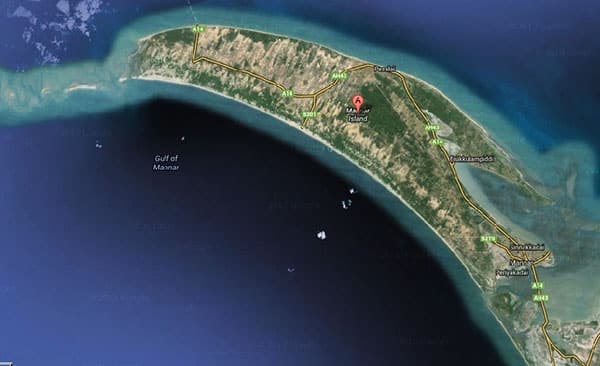
Mannar Basin natural gas is back at the centre of Sri Lanka’s energy conversation after the Ceylon Petroleum Corporation said it would begin seeking investors to extract and utilise the country’s offshore natural gas resources.
The announcement is important, but it needs to be understood correctly. Sri Lanka has not suddenly discovered gas in August 2026. The Dorado and Barracuda discoveries in the northern Mannar Basin date back to 2011 and demonstrated that a functioning petroleum system exists offshore Sri Lanka. What is changing now is the effort to move from geological knowledge towards a commercially investable project.
CPC Managing Director Dr. Mayura Neththikumara said on 13 August that the presence of gas had been scientifically confirmed by the Petroleum Development Authority of Sri Lanka and that the process of selecting a suitable investor would begin during the month. Interested parties are expected to receive approximately five months to submit proposals.
That could represent one of Sri Lanka’s most consequential energy decisions in years. But whether Mannar gas ultimately becomes an economic asset will depend on something far more complicated than proving that hydrocarbons exist beneath the seabed.
Mannar Basin Natural Gas Is a Commercial Question Now
The distinction between discovering gas and developing gas matters enormously.
Technical assessments of the Dorado and Barracuda discoveries have placed their combined mid-case recoverable potential at around 839 billion cubic feet of gas, together with approximately 5.9 million barrels of condensate. Those numbers are useful for understanding possible scale, but they should not be treated as guaranteed commercial reserves.
A resource becomes economically meaningful only after further appraisal answers several questions: how much gas can actually be recovered, at what production rate, how much offshore infrastructure will be required, what the development will cost and who will purchase the gas at a price capable of supporting the investment.
The fact that the discoveries have remained undeveloped for around 15 years illustrates exactly why this distinction matters. Offshore gas projects can require very large upfront expenditure before the first commercial unit of energy is produced.
Sri Lanka therefore should not begin from the assumption that Mannar represents a financial windfall. It should begin with a bankability test.
Why the Timing Suddenly Looks More Attractive
Sri Lanka’s exposure to imported energy has again become highly visible in 2026.
Fuel import expenditure reached approximately US$3.17 billion during the first six months of 2026, an increase of 58.8% from the corresponding period a year earlier. Higher fuel costs contributed to the widening merchandise trade deficit and helped push the country’s current account into deficit during the second quarter.
That is precisely the type of external vulnerability domestic gas could potentially reduce.
If locally produced gas can replace part of the imported petroleum products currently used for power generation or industrial energy, Sri Lanka could reduce its exposure to international fuel-price shocks and the foreign-exchange requirements associated with imported energy.
The important word, however, is if.
Domestic production does not automatically mean cheap energy. Offshore development costs, investor returns, processing facilities, pipelines, operating expenditure and the price agreed for domestic gas will all influence the final cost.
A badly structured domestic gas project could still produce expensive electricity. A well-structured one could provide valuable protection against international market volatility.
Gas Could Support the Power System – But It Should Not Replace the Renewable Plan
Sri Lanka has another reason to examine Mannar gas carefully: the electricity system is moving towards much higher shares of variable renewable energy.
The country continues to target 70% renewable electricity generation by 2030 and carbon neutrality in power generation by 2050. The Ceylon Electricity Board’s current long-term generation planning also envisages future capacity being dominated by renewable additions, while thermal plants increasingly provide flexible support to maintain system reliability.
That creates a potentially sensible role for natural gas.
Gas-fired generators can respond more flexibly than traditional coal plants, making them useful when solar generation falls in the evening or wind production changes unexpectedly. Used in this way, domestic gas could support greater integration of solar and wind rather than competing with them.
But this is where policy discipline becomes critical.
Sri Lanka should avoid building so much long-life gas infrastructure that future governments feel financially compelled to keep gas plants operating simply to recover sunk investment. Pipelines, processing facilities and power stations can remain in service for decades.
The correct question is therefore not whether Sri Lanka should choose gas or renewable energy. It is how much gas infrastructure is actually required to support a renewable-heavy energy system.
That should be determined through power-system modelling before major investment commitments are made.
The Investor Deal May Matter More Than the Discovery
The quality of the investment structure will determine how much value ultimately remains in Sri Lanka.
Offshore petroleum projects typically involve complex arrangements covering exploration risk, development expenditure, production rights, royalties, taxation, cost recovery and profit sharing. Investors will understandably require returns that compensate them for geological, engineering and political risks.
Sri Lanka, however, must avoid a situation in which it bears significant long-term environmental or infrastructure obligations while receiving only a limited share of the economic benefit.
The commercial framework should clearly establish how government revenue is calculated, how domestic gas will be priced, what expenditure investors may recover, what local companies can supply and who carries responsibility when production ends.
Transparency will be particularly important because headline estimates of the theoretical value of offshore resources can create unrealistic public expectations long before commercial production begins.
A strong agreement would focus less on dramatic resource valuations and more on measurable national benefits: affordable energy, government revenue, foreign-exchange savings, domestic supply-chain participation and technology transfer.
CPC and PDASL Need Clearly Defined Roles
Institutional clarity will also matter.
The Petroleum Development Authority of Sri Lanka is the statutory regulator responsible for exploration, development and production of petroleum resources under the Petroleum Resources Act. CPC, meanwhile, has now announced that it will proceed with the investor-selection process.
There is nothing inherently problematic about several public institutions participating in a major energy project, but commercial, procurement and regulatory functions need clearly defined boundaries.
Investors need certainty over who grants rights, who supervises production, who purchases gas and who enforces safety and environmental conditions. The public also needs confidence that the same institution benefiting commercially from a project is not effectively regulating its own performance.
A successful Mannar development therefore requires governance architecture alongside engineering.
Mannar’s Environment Cannot Become an Afterthought
The offshore location introduces another layer of risk.
Petroleum development can disturb seabed habitats during drilling and infrastructure installation, create underwater noise, produce drilling wastes and introduce spill and accident risks. Offshore operations can also intersect with fishing activity and other marine livelihoods.
This does not mean gas development and environmental protection are automatically incompatible. It means environmental considerations need to shape the project before the investment is locked in.
Mannar is already an important region for fisheries, coastal ecosystems and migratory bird habitats, while northern Sri Lanka is simultaneously being assessed for substantial renewable-energy development. Environmental planning therefore cannot examine each new energy project in isolation.
Detailed environmental and social assessments should identify drilling locations, pipeline routes, fishing grounds and sensitive habitats before final development approval. Fisher communities should be consulted early enough for their information to affect project design, rather than after key decisions have already been made.
Investors should also be required to demonstrate internationally credible emergency-response capability and provide financial security for environmental remediation and eventual decommissioning.
Methane Is the Sustainability Test Sri Lanka Should Set From Day One
There is also a climate issue that cannot be solved simply by describing gas as cleaner than coal or fuel oil.
Natural gas is primarily methane. While gas combustion can produce lower carbon dioxide emissions than some other fossil fuels, leakage during production, processing and transportation can significantly weaken that advantage.
This is especially relevant because methane is a powerful short-lived greenhouse gas. International energy agencies now place strong emphasis on detecting and eliminating leaks throughout oil and gas supply chains.
Sri Lanka has an advantage here because it would be developing new infrastructure rather than attempting to repair an ageing industry.
Contracts could require continuous methane measurement, regular leak-detection and repair programmes, strict limitations on venting, avoidance of routine flaring and transparent publication of emissions data.
These requirements should be built into the investment framework rather than negotiated later as optional environmental improvements.
Modern methane control is not simply a climate expense either. Gas that leaks into the atmosphere is gas that cannot be sold.
Decommissioning Must Be Paid for Before Production Starts
One of the least discussed parts of petroleum development is what happens when the field reaches the end of its commercial life.
Wells must eventually be sealed. Offshore structures may need to be removed. Pipelines must be made safe and sites restored.
If those obligations are not properly funded, countries can inherit expensive liabilities after investors leave.
Sri Lanka should therefore require a legally enforceable decommissioning plan and a progressively funded financial mechanism during the productive life of any Mannar project.
The principle should be straightforward: future taxpayers should not pay to clean up today’s energy investment.
That safeguard becomes particularly important for a country managing constrained public finances.
There Is Also a Local Business Opportunity
If the project moves forward, the opportunity will extend beyond gas sales.
Offshore energy development requires engineering, marine logistics, maintenance, fabrication, environmental monitoring, professional services, safety systems, transport and specialised technical labour.
Sri Lankan companies will not immediately possess every capability required for a deep-water gas development, nor should unrealistic local-content requirements make the project uneconomic.
But the investment agreement can create a practical pathway for domestic firms and workers to gradually participate.
Training partnerships with universities and technical institutions, supplier-development programmes and requirements for knowledge transfer could allow part of the project’s expenditure to remain within the Sri Lankan economy.
That would create a more durable benefit than relying entirely on royalties or tax receipts.
Sri Lanka Should Develop the Gas – Only If the Numbers Survive Scrutiny
The latest Mannar announcement deserves optimism, but not hype.
Sri Lanka has evidence of a domestic gas resource at a time when imported fuel has again become a major pressure on the external account. If the fields prove commercially viable, domestic gas could strengthen energy security, reduce part of the country’s foreign-exchange exposure, support flexible electricity generation and create a new technical industry.
Yet all of those benefits depend on the project being designed correctly.
Sri Lanka needs to know the actual recoverable volume, development cost and domestic gas price before committing to large supporting infrastructure. Environmental safeguards, methane controls and decommissioning funding should be contractual requirements. The investor agreement must deliver a reasonable share of economic value to the country, while the power-sector strategy must ensure gas complements rather than slows renewable energy.
Perhaps the most important lesson is that Mannar should not be treated as Sri Lanka’s escape from the energy transition.
It could instead become part of that transition.
Used carefully, domestic gas could provide flexibility and energy security while Sri Lanka builds a much larger renewable system. Developed without discipline, it could leave the country with another generation of expensive fossil-fuel infrastructure and environmental obligations.
The gas beneath Mannar may be valuable.
The bigger test is whether Sri Lanka can prove that the way it develops that gas will be equally valuable.
This article is for educational, business analysis and news purposes only. Estimates of gas resources should not be interpreted as guaranteed commercially recoverable reserves. Commercial viability will depend on appraisal, investment costs, contractual terms and future energy-market conditions.