Hela Apparel insolvency is not simply a story of an apparel exporter losing orders or a company being overwhelmed by one difficult year. It is a more important case study in the difference between revenue growth and financially sustainable growth.
On 5 August 2026, Hela Apparel Holdings PLC and two key subsidiaries filed applications seeking court-ordered winding up after the Board concluded that continuing liquidity constraints had left the businesses unable to pay their debts. The filing followed years of debt restructuring, equity injections, operational restructuring and attempts to secure new investment. A court application, however, is not the same as a final winding-up order, which remains a matter for the judicial process.
The more revealing question is what happened before this point.
Four years earlier, Hela entered the Colombo Stock Exchange through one of Sri Lanka’s largest recent IPOs, raising just over Rs. 4 billion. It subsequently obtained US$14 million in international development financing, returned to shareholders for approximately Rs. 1.6 billion through a rights issue and pursued repeated negotiations to restructure bank debt.
Yet by March 2025, Group borrowings still stood above Rs. 31 billion.
That makes Hela relevant far beyond the apparel industry. It raises a fundamental capital-allocation question for any rapidly expanding business: how much growth can a balance sheet safely support?
Hela Apparel Insolvency: The Question Is Where the Capital Went
The 2022 IPO is the logical place to begin, but one important distinction is necessary.
Hela’s original prospectus never proposed using all Rs. 4 billion purely for expansion. Approximately Rs. 2 billion was already earmarked for the retirement of short-term debt. Around Rs. 1 billion was allocated for a fabric mill, Rs. 596 million for a new ERP system and roughly Rs. 411 million for productivity-enhancing capital expenditure through subsidiaries.
So deleveraging was part of the IPO strategy from the beginning.
What changed dramatically was the proportion.
By May 2022, following the collapse of the Sri Lankan rupee and sharp increases in borrowing costs, Hela disclosed that approximately Rs. 3.91 billion of the Rs. 4 billion IPO proceeds would effectively be directed towards an expanded debt-restructuring exercise. Major elements of the fabric, ERP and productivity investment programme were deferred.
That decision was understandable as a defensive response to an extraordinary economic crisis. Dollar-denominated debt had become significantly more expensive in rupee terms, while domestic interest rates had surged.
But it also changed the economic character of the IPO.
Capital that could have produced new capacity, vertical integration, automation and future productivity was instead being used largely to repair the existing balance sheet. The company received liquidity and lower immediate debt pressure, but much less of the original equity raise was available to generate the future cash flows envisaged under the investment programme.
The Rs. 19.25 Valuation Met a Very Different Economy
The IPO was priced at Rs. 15 per share against an independent DCF reference valuation of Rs. 19.25, representing a 22.1% discount to that reference point.
But the valuation document itself contained an important warning: the DCF value depended on the viability of its underlying forecasts and assumptions. The valuation date was 30 September 2021, before Sri Lanka’s 2022 foreign-exchange crisis, sovereign default, extreme interest-rate increases and currency adjustment.
This does not mean the original valuation was necessarily unreasonable when prepared.
It demonstrates something more fundamental about valuation: a DCF is only as durable as the assumptions supporting future cash flows, financing costs and working-capital requirements.
Hela’s projected future existed in one macroeconomic environment. Within months of listing, the company was operating in another.
For investors, the key issue after such a shock was no longer whether Rs. 15 represented a discount to Rs. 19.25. It was whether the original cash-flow assumptions still remained achievable.
The Credit Ratings Told an Increasingly Different Story
The sequence of Fitch Ratings actions provides one of the clearest public warning trails.
In March 2022, Fitch assigned Hela a first-time AA(lka) National Long-Term Rating with a Stable Outlook. One year later, the rating was lowered to AA-(lka) with a Negative Outlook as Fitch forecast weaker leverage and interest coverage.
Then came the more significant move.
In November 2023, Fitch downgraded Hela to BB+(lka) with a Negative Outlook. It cited additional operating costs, a substantial reduction in EBIT and higher finance costs, with EBITDA interest coverage falling to only 0.3 times. The rating was subsequently affirmed at BB+(lka) before Fitch withdrew it for commercial reasons in December 2023.
Ratings are not predictions of inevitable insolvency. But such a rapid movement from AA to BB+ should change the questions investors ask.
At that point, revenue growth alone was no longer the central metric. Refinancing capacity, interest coverage, free cash flow and working-capital dependence had become increasingly important.
Norfund Capital Supported Expansion – but Could Not Solve the Whole Balance Sheet
Hela continued developing its international footprint.
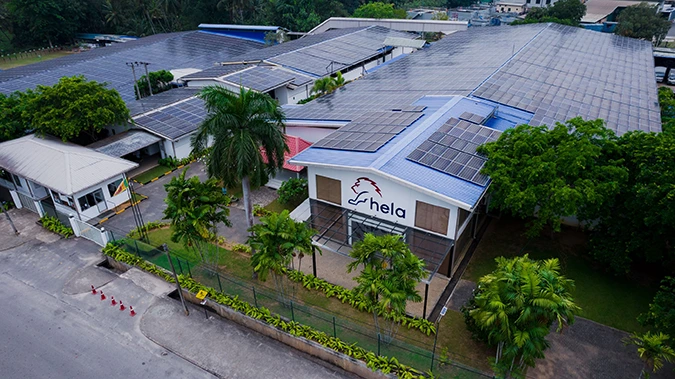
In February 2023, Norwegian development-finance institution Norfund signed a US$14 million financing agreement with Hela to support manufacturing operations in East Africa, particularly additional investment in Kenya and development of the regional supply chain.
This financing should not be characterised simply as an emergency injection into the Sri Lankan parent. It had a defined development and expansion purpose.
That distinction is central to understanding Hela.
The Group possessed an identifiable growth strategy: international manufacturing, proximity to major markets, scale, supply-chain diversification and later brand-management capabilities.
The unanswered financial question was whether the capital structure funding that strategy had enough resilience when operating assumptions weakened.
Expansion can be commercially logical while still increasing financial vulnerability if the underlying business remains heavily dependent on working-capital borrowing and refinancing.
Another Rs. 1.6 Billion of Equity, Again Directed Towards Debt
By June 2024, Hela returned to its shareholders.
The company announced a rights issue of 319.4 million shares at Rs. 5 each to raise approximately Rs. 1.60 billion. The issue was subsequently oversubscribed. Company disclosures show that the proceeds, after costs, were channelled through subsidiaries towards settling existing bank borrowings.
This creates one of the strongest signals in the Hela capital story.
The 2022 IPO had already supplied Rs. 4 billion of equity, most of which ultimately went towards debt restructuring. Two years later, another sizeable equity injection was again required principally to reduce borrowings.
Yet the debt stock remained substantial.
Fresh equity being used to retire debt is not inherently negative; deleveraging can protect shareholders by reducing financial risk. But when repeated equity injections fail to materially change the overall debt burden, investors need to examine whether operating cash flows are rebuilding borrowings between capital raises.
Revenue Growth Hid What Was Happening Underneath
Hela’s FY2024/25 numbers provide perhaps the most important lesson.
Group revenue increased by 18.6%, from Rs. 70.3 billion to Rs. 83.4 billion. Viewed alone, this appears to describe a growing company.
It does not.
The increase was primarily driven by a full-year contribution of Rs. 27.4 billion from the Brand Licensing Division, following the acquisition of Focus Brands. Meanwhile, Hela’s core Private Label Manufacturing Division recorded revenue of Rs. 55.9 billion, down 13.3% in rupee terms and 7% in US-dollar terms.
The profitability comparison requires similar care.
The FY2023/24 operating profit of Rs. 1.7 billion included a Rs. 9.6 billion bargain-purchase gain associated with the Focus Brands acquisition. Conversely, FY2024/25 contained approximately Rs. 10 billion of non-cash impairment charges.
Excluding those FY25 impairment charges, Hela still reported an underlying consolidated operating loss of approximately Rs. 6.3 billion, driven primarily by the manufacturing division.
This is more revealing than simply comparing a Rs. 1.7 billion accounting profit with a Rs. 15.7 billion reported operating loss.
The real problem was that revenue scale was no longer translating into sufficient operating cash generation.
The Balance Sheet Had Almost No Margin for Error
By 31 March 2025, the financial structure had become exceptionally tight.
Hela reported Rs. 31.3 billion in borrowings and net debt of approximately Rs. 26.9 billion. Around Rs. 31 billion of borrowings were contractually due within 12 months, while more than 92% of borrowings were floating-rate.
That did not mean every working-capital facility had to disappear immediately; revolving facilities can be renewed. But it meant continued lender support and refinancing were fundamental to liquidity.
The Group also reported a Rs. 20.4 billion net current liability position, negative equity of roughly Rs. 11 billion and Rs. 4.4 billion of operating cash outflows. Trade payables included overdue amounts, covenant breaches had occurred, and corporate guarantees across Group entities totalled Rs. 38.2 billion.
Its auditors ultimately issued a Disclaimer of Opinion, stating that they could not obtain sufficient appropriate evidence to form an audit opinion amid significant going-concern uncertainties.
By then, restructuring was no longer simply about improving the cost of capital. It had become essential to continuing operations.
Were External Shocks the Cause or the Trigger?
It would be too simplistic to conclude that Hela’s difficulties resulted solely from aggressive expansion.
The company faced an extraordinary sequence of external events: Sri Lanka’s currency and interest-rate crisis, weaker global apparel demand, high financing costs, Red Sea shipping disruptions, geopolitical uncertainty and changing international sourcing conditions. Hela’s own reporting identifies several of these pressures.
A lower-leveraged company would also have suffered from those shocks.
The more important analytical point is that leverage determines how much room a business has to absorb them.
Hela’s strategy required working capital, debt availability and future cash generation to remain supportive while the Group expanded internationally and broadened its operations. When operating margins weakened and financing became more expensive, new equity increasingly went towards defending the balance sheet rather than financing the productivity improvements originally intended.
External shocks therefore appear less like a complete explanation and more like an accelerant acting on an already demanding capital structure.
What Could an Investor Have Seen?
The Hela story was not one in which every warning appeared simultaneously.
They accumulated.
The redirection of almost the entire IPO raise towards debt restructuring showed that the original capital plan had changed. The subsequent rating downgrades highlighted weaker interest coverage. International financing supported expansion, but debt pressure remained. The 2024 rights issue required shareholders to provide fresh equity for another debt reduction exercise.
Then the FY2025 accounts showed that headline revenue growth was masking weakness in core manufacturing, while losses, cash outflows and current liabilities were intensifying.
None of these individual events guaranteed the eventual winding-up application.
Taken together, however, they progressively changed the risk profile.
That is the broader lesson for investors: capital raising should not be confused with capital generation. A company can repeatedly access debt and equity markets while its underlying operating activities remain unable to generate enough sustainable cash flow to support the capital structure.
A Case Study in Financially Sustainable Growth
Hela demonstrated that a Sri Lankan apparel company could build an international manufacturing footprint, attract development finance, work with global brands and access public capital markets.
The eventual financial distress does not erase those achievements.
But the balance-sheet outcome raises a difficult question about the pace and financing of that growth.
Despite a Rs. 4 billion IPO, US$14 million of development financing, another Rs. 1.6 billion from shareholders and repeated restructuring efforts, Hela entered FY2025 with more than Rs. 31 billion in borrowings and insufficient operating cash generation to comfortably service its obligations.
The evidence therefore supports a nuanced conclusion.
Hela was not simply a business that stopped growing. In its final audited year, reported revenue actually increased.
Its problem was that growth, accounting revenue and financial sustainability had become three very different things.
For Sri Lankan listed companies, investors and boards, that may be the most important lesson from Hela: expansion creates shareholder value only when the balance sheet can survive the journey.
This article is based on publicly available corporate disclosures and is intended for educational, business analysis and news purposes only. It does not assign legal liability or constitute investment advice. Hela Apparel Holdings PLC’s court winding-up application was pending at the time of analysis.