
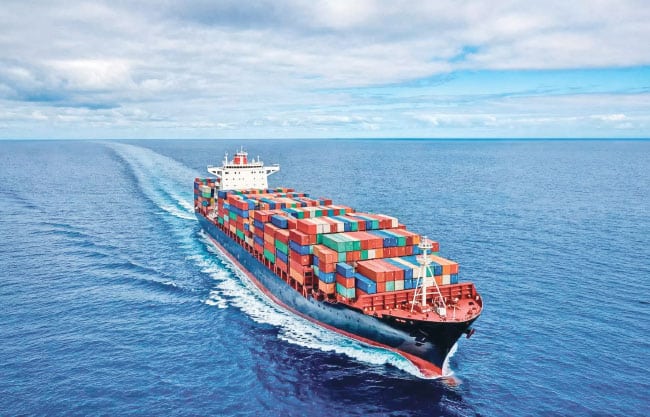
The rising cost of shipping and freight has quietly emerged as one of the most serious hidden threats to Sri Lanka exporters in early 2026. While global attention often focuses on fuel prices or currency movements, the sharp escalation in ocean freight rates, container transport charges and related surcharges is directly squeezing export margins and threatening competitiveness. In March 2026, container transport charges rose by 20%, adding hundreds of dollars to end-to-end shipping costs for both exporters and importers.
Sea freight rates on key routes have surged by an additional USD 1,000 to 1,500 per container, while carriers have introduced war-risk premiums and fuel surcharges linked to Middle East disruptions, including rerouting around the Strait of Hormuz. For apparel, tea, rubber products and electronics manufacturers sectors that rely heavily on timely, cost-effective sea freight these increases are no longer abstract; they are eroding profitability and forcing urgent strategic adjustments. Exporters who treat freight cost pressure as a temporary blip risk losing market share, but those who respond proactively with smarter logistics planning can protect margins and even turn the challenge into a competitive edge.
Also in Explained | Why Services Exports (ICT/BPM) May Be Sri Lanka’s Next Big Export Engine
Rising Cost of Shipping and Freight
The freight cost surge in early 2026 stems from a combination of persistent global disruptions and regional tensions. The ongoing Middle East conflict has forced many carriers to reroute vessels away from the Strait of Hormuz and Red Sea corridors, adding 10–14 days to voyage times and significantly raising fuel consumption. This has triggered a wave of emergency surcharges, with major lines such as MSC announcing new rates from Colombo to Europe effective 1 March 2026: USD 1,550 for a 20-foot container and USD 1,850 for 40-foot and 45-foot high-cube containers to Antwerp and Valencia.
These figures already include base ocean freight, origin terminal handling, port surcharges, contingency adjustments, piracy risk and emission control area fees yet additional war-risk and fuel surcharges are being layered on top. Domestically, the 20% hike in container transport charges implemented in late March 2026 has further compounded the burden. Industry sources report that this increase alone has raised end-to-end shipping costs for exporters by a noticeable margin, affecting everything from inland haulage to port handling.
Colombo Port itself continues to perform strongly on the transshipment side, with volumes up 14.9% in January 2026, but this growth masks the pain felt by local exporters who must absorb higher freight rates while competing against suppliers in countries with more stable logistics corridors. For time-sensitive or perishable exports such as fresh produce and apparel, the combination of longer transit times and elevated costs is particularly damaging, often leading to missed delivery windows or the need for costlier air freight as a last resort.
Margin Compression and Competitiveness Risks for Key Export Sectors
The freight cost escalation is not evenly distributed, it hits Sri Lanka’s export basket hardest where margins are already thin. Apparel and textile manufacturers, which account for a large share of merchandise exports, face compounded pressure because many contracts are priced on a cost-insurance-freight (CIF) basis or involve tight buyer negotiations that leave little room to pass on increases. A USD 1,000–1,500 rise per container can erase weeks of profit on a mid-sized shipment, forcing factories to either absorb the hit or risk losing orders to lower-cost competitors in Bangladesh or Vietnam.
Similar dynamics affect agricultural and industrial exporters. Tea and rubber product shipments, often destined for Europe and North America, now carry significantly higher logistics costs that reduce net realisations for growers and processors. Electronics and value-added manufacturing segments, which have been key drivers of recent export growth, are also vulnerable because buyers in these categories expect stable pricing and reliable delivery.
The net result is margin compression across the board, delayed investment in capacity expansion, and potential order cancellations if freight costs continue to climb unchecked. Smaller exporters and SMEs, which lack the negotiating power of larger conglomerates, are feeling the squeeze most acutely, with some already reporting reduced profitability or the need to scale back shipments. In a global environment where buyers are increasingly price-sensitive, unchecked freight inflation risks eroding Sri Lanka’s hard-won export momentum and market share.
Practical Strategies Exporters Can Use to Mitigate Freight Cost Pressure
Exporters do not have to accept rising shipping and freight costs as an uncontrollable external force. Several practical, implementable responses can help protect margins and maintain competitiveness. First, negotiate longer-term freight contracts or volume-based agreements with carriers to lock in rates and minimise exposure to spot-market spikes and sudden surcharges. Second, optimise container utilisation through better packing, consolidated shipments or collaboration with other exporters to achieve economies of scale. Third, explore alternative routing options including transshipment through more stable hubs or direct services where available while carefully weighing the trade-off between cost and transit time.
Technology and data can also play a decisive role. Real-time freight rate tracking tools and digital logistics platforms allow exporters to benchmark quotes, anticipate surcharges and choose the most cost-effective carriers or routes. Investing in energy-efficient packaging or shifting to higher-value, lower-volume products can reduce the per-unit impact of freight. For larger exporters, captive or shared logistics solutions such as dedicated container services or partnerships with freight forwarders offer greater control over costs and schedules.
Government and industry support, including any trade facilitation measures or export financing schemes that help offset logistics expenses, should be actively pursued. Finally, building stronger relationships with buyers to share freight cost increases transparently or renegotiate Incoterms (for example, moving from CIF to FOB where feasible) can distribute the burden more equitably. The exporters who succeed in this environment will be those who treat freight management as a core strategic function rather than a routine operational expense.
Turning Freight Cost Challenges into Sustainable Export Resilience
Sri Lanka’s exporters are confronting a clear and present threat from rising shipping and freight costs, but the situation also presents an opportunity to build greater long-term resilience. The 20% container transport charge increase, combined with global surcharges driven by Middle East disruptions, has made logistics a boardroom-level issue rather than a back-office concern. Businesses that respond with proactive planning from contract negotiations and route optimisation to technology adoption and buyer collaboration can limit margin erosion and even strengthen their competitive position.
The early 2026 data shows that while freight pressures are real, Sri Lanka’s export sector retains underlying strengths in quality, reliability and diversification. By treating higher shipping costs as a catalyst for smarter logistics and supply-chain innovation, exporters can safeguard profitability, protect jobs and contribute to sustained trade growth. The coming months will separate those who merely react to freight cost increases from those who strategically adapt and emerge stronger. In a volatile global trade environment, freight resilience is no longer optional, it is a critical driver of export success.
Also in Explained | Central Bank Rate Stability in the Face of Global Uncertainty: What Business Planners Should Know