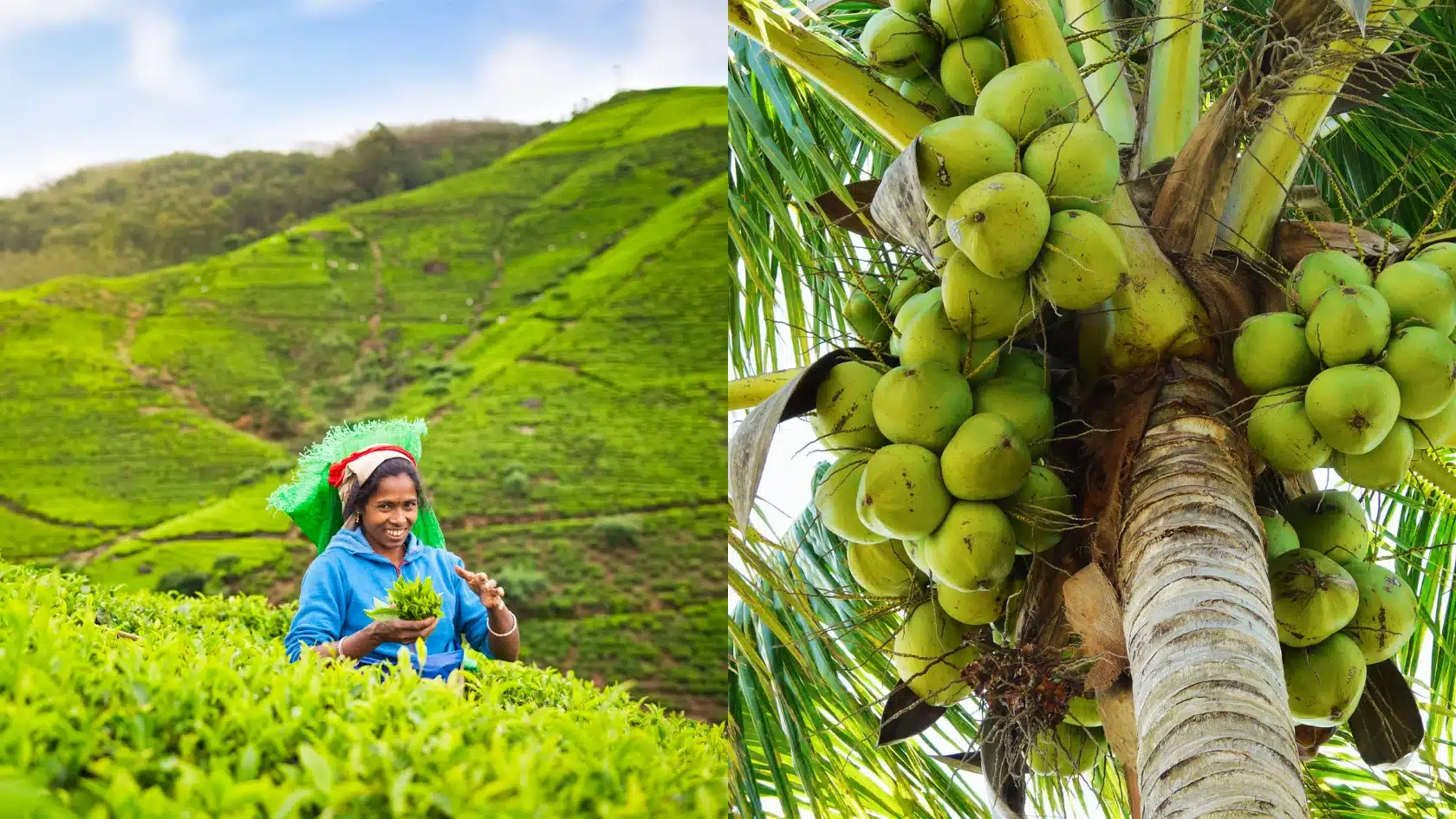
Why tea and coconut exports are rebounding has become one of the most encouraging chapters in Sri Lanka’s early 2026 export story. While apparel faced headwinds and global uncertainty lingered, traditional agricultural commodities delivered strong, consistent growth that helped stabilise the external sector. In the January–February 2026 period, tea exports rose 2.04% to US$ 236.84 million, and coconut-based products surged 27.86% to US$ 203.01 million.
These gains came as merchandise exports overall posted modest growth, underscoring how value-added diversification within long-established sectors is quietly powering Sri Lanka’s trade resilience. For an economy aiming for the US$ 20 billion export target in 2026, tea and coconut are proving that traditional strengths when combined with innovation, quality upgrades and market expansion remain powerful stabilisers and growth drivers.
Also in Explained | What Apparel Export Decline Tells Us About Global Demand Shifts
Tea Exports: Steady Recovery Through Quality and Market Diversification
Sri Lanka’s tea sector has shown encouraging resilience in the opening months of 2026. Cumulative January–February earnings reached US$ 236.84 million, a 2.04% increase over the same period in 2025. Volume exports also edged higher, with total shipments of 40.63 million kilograms up from 39.77 million kilograms the previous year. January delivered particularly strong results, with earnings climbing 8.11% to US$ 121.84 million on the back of robust bulk tea and packet tea demand. Key markets such as Turkey, Russia and Saudi Arabia recorded sharp increases, highlighting successful diversification beyond traditional Western buyers.
The rebound reflects deliberate industry efforts to enhance value addition and quality positioning. Exporters have focused on premium grades, specialty teas and sustainable certifications that command higher prices in growing Middle Eastern and Asian markets. Even as February saw some softening due to global headwinds, the cumulative performance demonstrates that Ceylon tea retains strong global appeal when supported by consistent supply and targeted marketing. This steady growth provides a reliable foreign-exchange cushion and supports hundreds of thousands of smallholder farmers and estate workers across the island’s tea regions. In an export basket increasingly dominated by services and industrial goods, tea’s contribution remains a vital anchor for rural economies and overall trade balance stability.
Coconut-Based Products: Explosive Growth Driven by Value Addition
Coconut exports have delivered one of the standout performances of early 2026, with earnings jumping 27.86% to US$ 203.01 million in the January–February period. This surge is even more impressive at the sub-category level: coconut kernel products rose sharply, led by coconut oil (+53.98%), desiccated coconut (+48.62%), coconut milk powder, coconut cream and liquid coconut milk. Coconut shell products, including activated carbon, also posted strong double-digit gains.
The rebound stems from successful long-term diversification into higher-value processed products rather than raw coconut. Global demand for natural, healthy ingredients in food, cosmetics, pharmaceuticals and industrial applications has favoured Sri Lanka’s quality-focused producers. Enhanced value addition has allowed exporters to capture more revenue per unit while reducing vulnerability to raw commodity price swings. February alone saw coconut-based earnings rise 25.22%, confirming the trend is broad-based and sustainable. This performance not only boosts foreign-exchange inflows but also creates downstream employment in processing, packaging and logistics across coconut-growing regions. Coconut’s success story illustrates how traditional plantation crops, when paired with innovation and market intelligence, can become dynamic engines of export growth.
How Tea and Coconut Contribute to Broader Export Diversification and Stability
The rebound in tea and coconut exports plays a crucial stabilising role within Sri Lanka’s overall trade strategy. While services (particularly ICT/BPM) and some industrial segments have driven headline growth, these traditional commodities provide balance and resilience. Agricultural exports as a group surged in January, and coconut’s strong contribution helped merchandise exports maintain positive momentum even as apparel faced demand softness. Together, tea and coconut demonstrate that Sri Lanka is successfully diversifying within its traditional strengths moving from low-value raw exports to higher-value, processed and branded products that fetch premium prices and face less intense low-cost competition.
This internal diversification reduces reliance on any single category or market, mitigating risks from global shocks such as energy price volatility or geopolitical disruptions. Strong performance in these sectors also supports rural livelihoods, foreign-exchange earnings and the current-account position. For policymakers and industry leaders, the early 2026 data validates continued investment in research, quality standards, sustainability certification and targeted market access initiatives. Tea and coconut are no longer just heritage crops they are active participants in Sri Lanka’s modern export diversification playbook.
Lessons and Future of Tea and Coconut Exports: Building on Traditional Strengths for Sustained Growth
The rebound in tea and coconut exports offers clear lessons for Sri Lanka’s broader export strategy. Success comes from focusing on value addition, quality differentiation, sustainable practices and proactive market diversification. Both sectors have shown that even mature industries can deliver strong growth when supported by innovation and global demand alignment. Looking ahead, sustaining this momentum will require continued investment in productivity, climate-resilient farming, digital traceability and new product development.
For the rest of 2026, tea and coconut are well positioned to contribute meaningfully toward the national US$ 20 billion export target. Their positive performance provides a buffer against volatility in other segments and reinforces Sri Lanka’s reputation as a reliable supplier of high-quality, ethically produced goods. Exporters, processors and smallholders who continue to embrace these diversification strategies will be best placed to capitalise on emerging opportunities in health-conscious, sustainable and premium markets worldwide.
Sri Lanka’s tea and coconut sectors are proving that traditional exports remain relevant and dynamic in a changing global landscape. Their rebound in early 2026 is more than a statistical bright spot, it is tangible evidence of successful diversification that stabilises the external sector, supports rural economies and strengthens the country’s overall trade resilience. By building on these success stories, Sri Lanka can create a more balanced, robust and future-ready export economy.
The information on this site has been included in good faith for general informational purposes only. It is not intended to amount to advice on which you should rely, and we give no representation, warranty or guarantee, whether express or implied as to its accuracy or completeness. You must obtain professional or specialist advice before taking, or refraining from, any action on the basis of the content on our site.