Sri Lanka’s rubber industry remains a pivotal force in the country’s export landscape, merging traditional agricultural roots with advanced manufacturing to generate substantial foreign revenue. Despite a 5.92% year-on-year decline in rubber and rubber finished products exports to US$ 793.7 million from January to October 2025, the sector demonstrates resilience amid global market fluctuations.
With the global rubber market valued at approximately US$ 48.77 billion in 2024 and projected to grow at a compound annual growth rate (CAGR) of 5.1% to reach US$ 65.65 billion by 2030, Sri Lankan stakeholders are eyeing expanded opportunities in sustainable and value-added segments. This article delves into the industry’s background, critical statistics, recent developments, business prospects, future trajectory, and broader significance, emphasizing its role in fostering economic growth and international competitiveness.
Also in Explained | Unlocking the Export Potential of Sri Lanka’s Cinnamon and Spices Sector
Background on Sri Lanka’s Rubber Industry
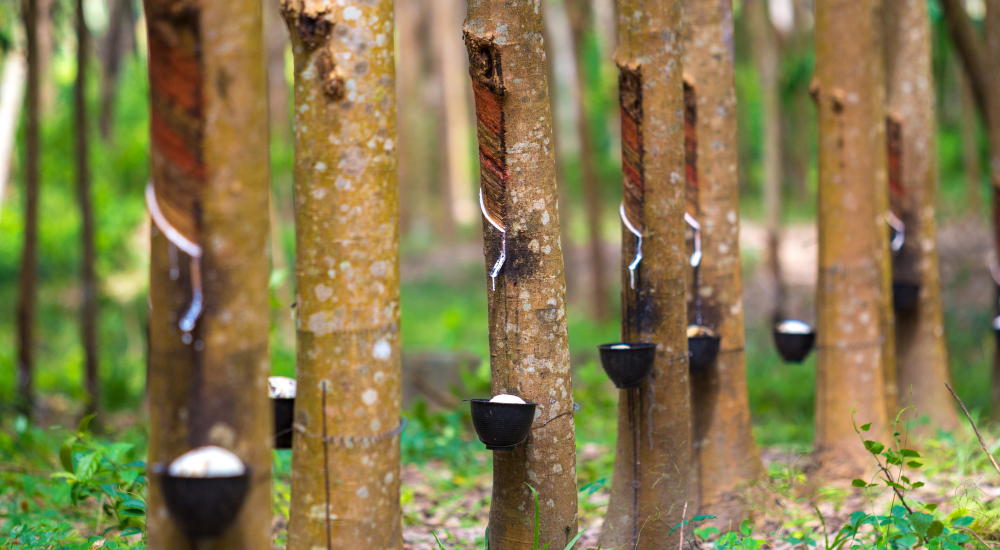
Introduced during the colonial period in the late 1800s, rubber cultivation has become integral to Sri Lanka’s economy, primarily in the humid low-country regions. The sector spans from raw natural rubber harvesting on plantations to the production of diverse finished goods, including tires, gloves, and engineering components. Annual domestic natural rubber production typically ranges between 78,000 and 82,000 metric tons, often augmented by imports to support manufacturing demands. This industry sustains employment for over 100,000 individuals, particularly in rural areas, while bolstering the nation’s trade balance through exports.
On a worldwide scale, rubber consumption is dominated by the automotive sector, which accounts for about 65% of demand, followed by uses in medical devices, construction materials, and everyday consumer items. Leading natural rubber suppliers include Thailand, Indonesia, and Vietnam, but Sri Lanka carves a niche with its premium latex quality and commitment to ethical labor standards. Nevertheless, challenges persist, such as declining productivity from mature trees and the predominance of small-scale holdings, which hinder efficiency and increase vulnerability to external factors like weather variability and international price swings.
Key Details, Insights, and Statistics
Export performance in 2025 showed mixed results for Sri Lanka’s rubber segment. From January to October, earnings from rubber and rubber products totaled US$ 793.7 million, marking a 5.92% drop from the prior year, primarily due to reduced shipments of pneumatic and retreaded tires, which declined by 15.21%. Earlier in the year, January to July figures stood at US$ 552.36 million, down 4.05%, though July alone saw a 10.10% increase to US$ 84.56 million, driven by stronger sales of tires and industrial gloves.
By September, cumulative exports reached US$ 713.62 million, reflecting a 5.97% decrease, with September’s monthly value at US$ 74.29 million, down 6.55%. 3 Extending to November, total merchandise exports hit US$ 15.77 billion with a 5.8% growth, suggesting rubber exports likely approached US$ 870 million for the 11-month period.
Comparatively, in 2024, rubber-based exports amounted to US$ 1,001.54 million, up from US$ 930.24 million in 2023, with an average annual growth of 2.48% from 2020 to 2024. Major destinations include the European Union, the United States, and Asian markets, where value-added products like surgical gloves and solid tires are particularly sought after.
Globally, the rubber market exhibited dynamism in 2025. The overall industry, encompassing both natural and synthetic variants, was estimated at US$ 44.94 billion in 2024, projected to expand to US$ 58.76 billion by 2030 at a 4.58% CAGR. Natural rubber specifically faced a projected modest production increase of 0.5% in 2025, amid concerns of shortages that could sustain elevated prices.
Prices followed a V-shaped pattern, rising early, dipping sharply, and rebounding, with December 2025 averages around US$ 1.82 per kilogram in Thailand and similar levels in other key regions. By early 2026, prices hovered at 182.60 US cents per kilogram, influenced by supply constraints and demand from tire manufacturing. The Asia-Pacific region continues to lead consumption, fueled by automotive expansion and infrastructure development.
Recent Changes and Implications
2025 brought several pivotal shifts to the rubber landscape. In Sri Lanka, export declines were linked to subdued demand for certain tire categories and global economic slowdowns affecting automotive sales. Internationally, the postponement of the European Union’s Deforestation Regulation delayed compliance burdens but introduced uncertainty, impacting 30-40% of Sri Lanka’s exports to Europe. Additionally, potential US tariff adjustments and falling oil prices contributed to natural rubber price volatility, with a downward trend observed in March amid regulatory delays.
Domestically, policy adjustments, including tax reforms, have strained cash flows for manufacturers, while environmental challenges like floods have reduced yields. Labor shortages, with over 70% of harvesting dependent on an aging workforce, underscore the urgency for modernization. These developments imply higher operational costs and the need for supply chain diversification. However, they also encourage a pivot toward sustainability, as eco-friendly certifications can secure premium pricing in regulated markets. Globally, rising crude oil costs could favor natural rubber over synthetics, potentially enhancing Sri Lanka’s competitive edge.
Business Perspectives and Opportunities
For enterprises, Sri Lanka’s rubber sector presents compelling avenues for growth and investment. The emphasis on value-added manufacturing, such as specialized gloves and components, allows for higher profit margins compared to raw exports. Businesses can capitalize on backward integration by investing in local plantations to minimize import dependency, thereby creating employment and stabilizing supplies.
Sustainability emerges as a prime opportunity: Adopting deforestation-free practices and obtaining certifications can unlock access to high-value European and North American markets. Collaborations with global firms could introduce advanced technologies, including resilient crop varieties and automated processing, boosting yields by up to 20%. The surge in electric vehicle production worldwide amplifies demand for low-rolling-resistance tires, where Sri Lankan expertise in natural rubber compounds can shine.
Small and medium-sized enterprises (SMEs) benefit from government programs offering training, financing, and export facilitation. Diversification into non-automotive areas, like healthcare products and construction seals, reduces exposure to sector-specific downturns. With global shortages looming, proactive businesses investing in innovation and green initiatives could see revenue growth exceeding 10% annually, contributing to broader economic diversification.
Future Vision and Outlook
Envisioning the future, Sri Lanka’s rubber industry aims to evolve into a sustainable, technology-driven powerhouse. By 2030, exports could surpass US$ 1.2 billion, aligned with global projections of the rubber market reaching US$ 65.65 billion. Initiatives like replanting with high-yield clones and implementing digital traceability will address productivity gaps and comply with international standards.
Challenges such as climate risks and workforce shortages will require ongoing attention, but emerging trends in circular economies “recycling rubber waste into new products” offer innovative solutions. Policy enhancements, including research incentives and trade agreements, will be vital. Globally, the natural rubber segment is forecasted to grow at 7.4% CAGR to US$ 30.11 billion by 2030, driven by demand in emerging economies. If Sri Lanka leverages these, the sector could achieve sustained growth, enhancing its global footprint.
Why It Matters
$2.2 billion export revenue is Sri Lanka’s target in 2030. The vitality of Sri Lanka’s rubber industry extends beyond economics, influencing rural development, employment stability, and environmental stewardship. As a key foreign exchange earner, it shields the economy from volatility and supports industrial linkages. On a global scale, it bolsters essential supply chains in automotive, healthcare, and infrastructure, promoting sustainable practices amid climate concerns.
For businesses, it unlocks innovation-driven profits; for policymakers, it highlights the importance of enabling environments. A robust rubber sector ultimately fortifies national resilience, drives inclusive progress, and cements Sri Lanka’s position in the dynamic international arena.
Also in Explained | Sri Lanka’s Gem and Jewellery Sector Targets $1 Billion Export Goal