The Central Bank of Sri Lanka (CBSL) has released its latest Financial Soundness Indicators (FSIs) for the third quarter of 2025, highlighting sustained resilience in the banking sector amid ongoing economic recovery. Licensed Commercial Banks and Licensed Specialised Banks reported improved capital positions, better asset quality, and robust profitability, reflecting the positive impact of macroeconomic stabilization efforts.
As Sri Lanka banking sector 2025 continues to support credit growth and financial inclusion, these indicators signal a stable foundation for lending and investment activities heading into 2026.
Also in Explained | Sri Lanka’s Debt Position: What It Means for Business, Investment, and Economic Stability
Strong Capital Buffers Amid Growth
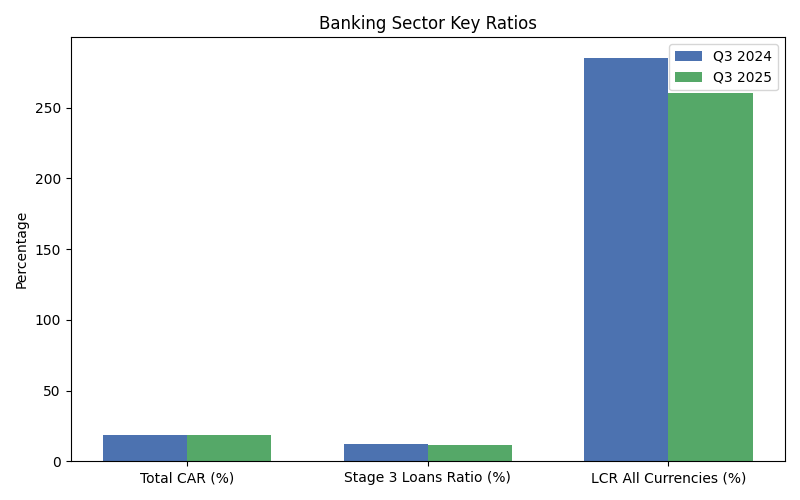
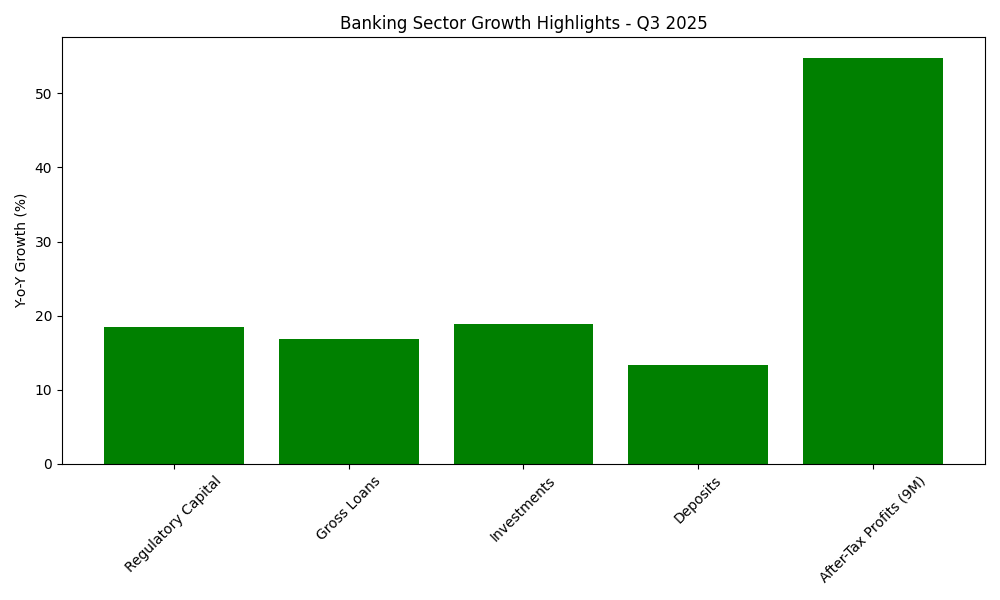
Capital adequacy in the banking sector showed marginal improvement, with the Total Capital Adequacy Ratio (CAR) rising to 18.6% at the end of Q3 2025 from 18.5% a year earlier. This was driven by an 18.4% year-on-year (Y-o-Y) increase in regulatory capital to Rs. 2,070.5 billion, outpacing the 17.6% growth in risk-weighted assets (RWA) to Rs. 11,146.1 billion.
Tier-1 capital strengthened by 21.5% to Rs. 1,700.4 billion, providing a solid core buffer against potential shocks. These levels remain well above regulatory minima, enhancing the sector’s capacity to absorb risks in a recovering economy.
Improving Asset Quality Signals Reduced Risks
Asset quality continued on a positive trajectory, with the Stage 3 (impaired) loans ratio declining to 11.2% from 12.4% in Q3 2024. Stage 3 loans grew only 1.8% Y-o-Y to Rs. 1,446.8 billion, while impairment charges rose moderately by 6.5% to Rs. 1,025.2 billion overall and 10.5% for Stage 3 loans to Rs. 814.8 billion.
This improvement reflects effective risk management and economic revival, particularly in sectors like real estate, where the Stage 3 ratio fell to 12.9% from 14.8%. Lower non-performing exposures bolster confidence for expanded lending.
Liquidity Remains Comfortable Despite Moderation
Liquidity metrics moderated slightly but stayed robust. The Liquidity Coverage Ratio (LCR) in all currencies dipped to 260.0% from 285.4%, and in rupees to 298.7% from 342.0%. The Net Stable Funding Ratio (NSFR) eased to 159.4% from 165.3%.
These figures indicate ample high-quality liquid assets to meet short-term obligations, supporting ongoing deposit growth and credit expansion without strain.
Profitability Surge Drives Sector Performance
Profitability reached new heights, with after-tax profits for the first nine months of 2025 soaring 54.8% Y-o-Y to Rs. 279.1 billion. This was fueled by a 21.8% rise in net interest income to Rs. 750.8 billion and a 25.9% increase in gross income to Rs. 953.8 billion.
Pre-tax profits climbed 51.7% to Rs. 434.3 billion, underscoring efficient operations and favorable interest rate dynamics.
Asset and Liability Growth Reflects Confidence
Total assets expanded 15.6% Y-o-Y to Rs. 24,501.5 billion, led by 16.9% growth in gross loans to Rs. 13,152.2 billion and 18.9% in investments to Rs. 9,683.7 billion. Deposits rose 13.4% to Rs. 19,668.9 billion, while borrowings increased 25.2% to Rs. 1,623.7 billion.
Equity and reserves grew 20.8% to Rs. 2,292.7 billion, reinforcing balance sheet strength. Foreign currency loans rose 18.7% to USD 9,135.4 million, indicating growing international exposure.
Business Implications for the Banking Sector
These strong FSIs position banks to capitalize on economic opportunities. Enhanced capital and profitability enable greater credit disbursement to priority sectors like SMEs, infrastructure, and tourism – key drivers of Sri Lanka economic recovery 2025.
For investors and depositors, the metrics affirm stability, potentially attracting foreign inflows. Banks can pursue digital innovations and green financing with reduced risk concerns.
Outlook and Strategic Importance
The Q3 2025 indicators underscore the banking sector’s role as a pillar of financial stability. Continued improvements in asset quality and earnings will support sustained growth, provided macroeconomic policies remain supportive.
As Sri Lanka navigates global uncertainties, a resilient banking system is vital for inclusive development and investor confidence.
Also in Explained | Shadow Imports Flood Sri Lanka’s Computer Hardware Market, Threatening Legitimate Businesses