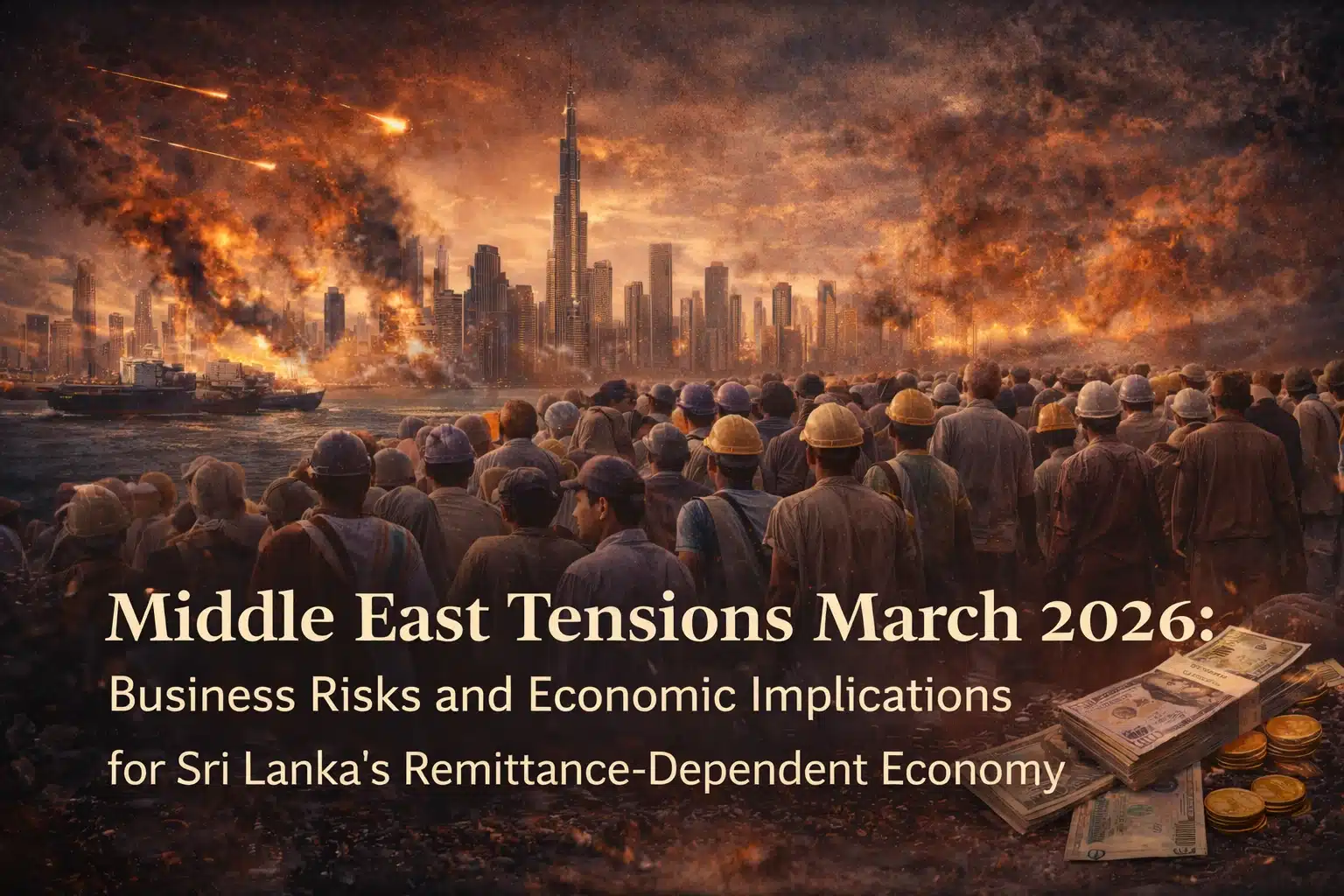
Sri Lanka’s economy continues to rely heavily on overseas employment as a key source of foreign exchange and household income. With escalating conflict in the Middle East in early March 2026, businesses, banks, remittance service providers, and policymakers are closely monitoring potential disruptions to the country’s largest migrant worker corridor.
As of 28 February 2026, official data shows 1,007,855 Sri Lankans residing across 14 Middle Eastern nations. The largest concentrations are in the UAE (350,000), Saudi Arabia (246,139), Kuwait (175,000), and Qatar (140,000). These workers, primarily in construction, domestic service, hospitality, and healthcare, generated a record USD 8.076 billion in remittances in 2025, a 22.8% increase from 2024 and a critical pillar supporting the balance of payments, foreign reserves, and domestic consumption.
This business-focused analysis examines the immediate and longer-term implications of the current regional tensions for Sri Lankan enterprises, financial institutions, and the broader economy, based solely on verified official updates as of 3 March 2026.
Also in Explained | How Is the Middle East Conflict Affecting Sri Lanka’s 2026 Tourism Targets?
Scale of Exposure: Remittances as a Core Business and Economic Driver
Middle Eastern markets dominate Sri Lanka’s foreign employment landscape. In 2025, remittances from the Gulf accounted for the majority of the USD 8.076 billion total inflow, directly boosting commercial bank liquidity, supporting import financing, and fuelling retail, real estate, and education spending at home.
Sri Lanka had set an ambitious target of deploying 310,000 new workers abroad in 2026, with Kuwait, the UAE, and Qatar expected to absorb the largest numbers. Any slowdown in hiring or project execution in the Gulf would immediately affect recruitment agencies, training institutes, medical screening centres, and travel operators specialising in labour migration.
For financial institutions, remittances represent a high-volume, stable revenue stream through transaction fees, foreign exchange spreads, and deposit mobilisation. A sustained reduction in inflows would pressure banks’ foreign currency positions and limit credit expansion to SMEs and households dependent on migrant support.
Immediate Business Risks: Disruptions, Cost Pressures, and Sectoral Impacts
As of 3 March 2026, the Sri Lanka Bureau of Foreign Employment (SLBFE) and Ministry of Foreign Affairs report no major casualties or large-scale evacuations among Sri Lankan workers. Diplomatic missions remain fully operational, and a 24-hour operations centre (hotline 1989) has been activated for real-time assistance.
However, practical business disruptions are already emerging. Airspace restrictions and temporary flight suspensions have delayed worker rotations, family visits, and new deployments. Construction and hospitality projects in affected areas have experienced short-term slowdowns due to heightened security protocols and supply-chain uncertainties, directly impacting demand for Sri Lankan labour.
Rising global oil prices triggered by tensions around the Strait of Hormuz are a major concern for Sri Lankan businesses. Higher fuel import costs would increase production and transportation expenses across manufacturing, logistics, and agriculture sectors, potentially feeding into inflation and squeezing corporate margins.
Tourism operators and airlines face secondary risks from possible aviation and maritime disruptions, which could affect arrival numbers and associated spending. Importers of essential goods and exporters reliant on Gulf markets for certain inputs must now factor in elevated insurance premiums and longer lead times.
For remittance service providers and commercial banks, even temporary delays in fund transfers or reduced worker confidence could slow inflows in the coming weeks, affecting liquidity planning and foreign exchange management.
Government Preparedness and Business Continuity Measures
The government has responded proactively to safeguard both workers and economic flows. Special operations centres have been established, coordination between embassies and the SLBFE strengthened, and contingency plans for repatriation activated if required. Tourist visas have been extended where necessary to maintain flexibility for returning workers or family members.
From a business perspective, these measures help minimise sudden shocks to remittance channels and labour supply pipelines. Banks and recruitment firms are advised to maintain close dialogue with the SLBFE and Central Bank to ensure smooth processing of existing contracts and timely foreign currency conversions.
Employers in Sri Lanka who depend on returning migrant savings for domestic investment particularly in construction, small-scale manufacturing, and services should prepare contingency financing options to bridge any short-term gaps in household cash flows.
Strategic Outlook: Diversification as a Business Imperative
The current tensions highlight Sri Lanka’s structural vulnerability to concentrated exposure in a single geographic region for both energy imports and foreign exchange earnings. While remittances remain a vital lifeline, businesses and policymakers must accelerate diversification strategies to build long-term resilience.
Opportunities exist to expand labour migration to more stable destinations in East Asia, Europe, and the Americas through targeted upskilling programmes in IT, healthcare, and technical trades. Domestic job creation initiatives in manufacturing, tourism, and digital services can reduce over-reliance on overseas employment while absorbing any returning workers.
Financial institutions can innovate remittance-linked products such as diaspora investment funds, insurance schemes, and foreign currency savings instruments to retain and channel inflows more productively into the local economy.
For the private sector, the situation underscores the need for robust risk management: scenario planning for oil price volatility, supply-chain diversification, and digital tools to maintain business continuity during external shocks.
In conclusion, the Middle East tensions of March 2026 represent a manageable but significant test for Sri Lanka’s remittance-driven economic model. With no immediate large-scale disruption reported as of 3 March, the focus for businesses should be on proactive monitoring, liquidity preservation, and accelerated diversification.
By treating this episode as a catalyst for stronger risk frameworks and geographic spread, Sri Lankan enterprises can emerge more resilient, ensuring that the contributions of migrant workers continue to support sustainable growth rather than expose the economy to repeated external volatility.
Also in Explained | What is Rural Tourism and How Can Sri Lanka Improve It for Greater Impact?