The Central Bank of Sri Lanka’s Q3 2025 Financial Soundness Indicators reveal a dynamic picture for the Licensed Finance Companies (LFCs) sector, marked by sharp improvements in asset quality and profitability alongside pressures on capital adequacy and liquidity as assets expand rapidly.
With the sector playing a crucial role in serving underserved segments like vehicle financing and SMEs, these trends highlight opportunities and challenges in Sri Lanka finance companies 2025.
Also in Explained | Sri Lanka’s Banking Sector Demonstrates Resilience in Q3 2025 Financial Soundness Indicators
Capital Adequacy Under Pressure from Rapid Expansion
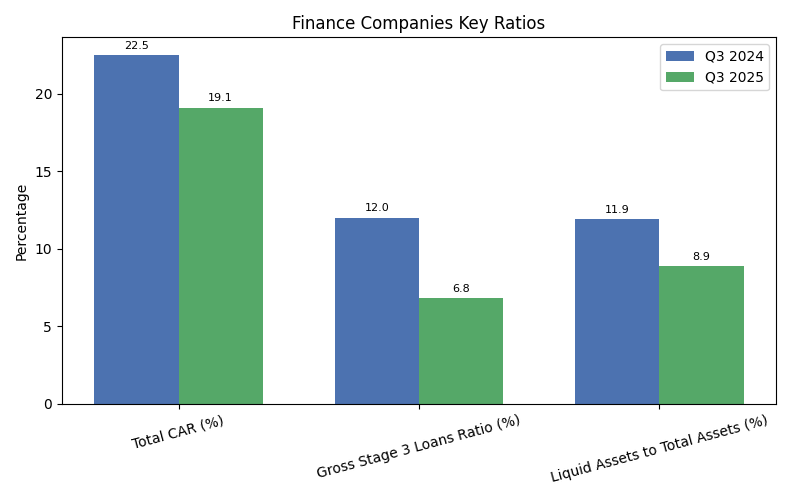
The Total CAR declined to 19.1% at end Q3 2025 from 22.5% a year ago, reflecting faster growth in RWA (37.3% Y-o-Y to Rs. 2,190.1 billion) compared to regulatory capital (16.7% to Rs. 418.1 billion). Tier-1 capital rose 12.1% to Rs. 389.0 billion.
Borrowings to equity doubled to 1.2 times from 0.6 times, indicating increased leverage to fund growth. Levels remain above requirements but warrant monitoring.
Significant Improvement in Asset Quality
Asset quality strengthened markedly, with the gross Stage 3 loans ratio halving to 6.8% from 12.0% in Q3 2024. Gross Stage 3 loans fell 18.3% Y-o-Y to Rs. 140.7 billion, net Stage 3 loans dropped 29.6% to Rs. 73.5 billion, and impairment coverage for Stage 3 improved to 47.7% from 39.3%.
This deleveraging of impaired assets reflects successful recoveries and prudent lending post-crisis.
Liquidity Metrics Reflect Funding Shifts
Liquidity ratios moderated as the sector scaled up. Liquid assets to total assets fell to 8.9% from 11.9%, and to deposits & borrowings to 12.0% from 17.0%. The credit to deposits ratio rose sharply to 169.3 from 141.8, signaling heavier reliance on borrowings.
These shifts align with aggressive lending but emphasize the need for diversified funding sources.
Profitability Rebounds Strongly
Profit after tax for the period surged 59.3% Y-o-Y to Rs. 41.9 billion. ROA improved to 6.9% from 5.7%, and ROE to 17.2% from 12.3%. Net interest income grew 26.6% to Rs. 119.7 billion, with gross income up 28.5% to Rs. 141.1 billion.
Higher margins and volume growth drove these gains.
Aggressive Balance Sheet Expansion
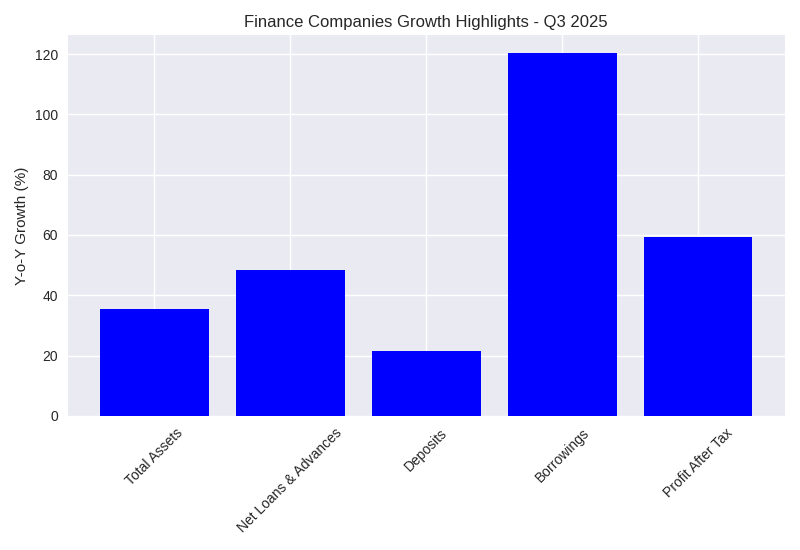
Total assets ballooned 35.3% Y-o-Y to Rs. 2,488.2 billion, propelled by 48.4% growth in net loans & advances to Rs. 1,989.2 billion. Deposits increased 21.6% to Rs. 1,228.5 billion, while borrowings surged 120.2% to Rs. 611.2 billion.
Equity grew 13.2% to Rs. 511.1 billion, supporting expansion but highlighting leverage trends.
Business Perspective for Licensed Finance Companies
The sector’s rapid growth opens avenues in niche markets like leasing and microfinance, complementing banks. Improved profitability attracts investors, while better asset quality reduces provisioning burdens.
However, tightening capital and liquidity call for strategic funding and risk management to sustain momentum.
Future Implications
Q3 2025 FSIs portray LFCs as agile players in financial inclusion, with strong earnings offsetting expansion risks. Prudent oversight will ensure balanced growth, contributing to broader Sri Lanka financial sector stability.
As demand for alternative financing rises, the sector is well-positioned for innovation and partnerships.
Also in Explained | Sri Lanka’s Debt Position: What It Means for Business, Investment, and Economic Stability