
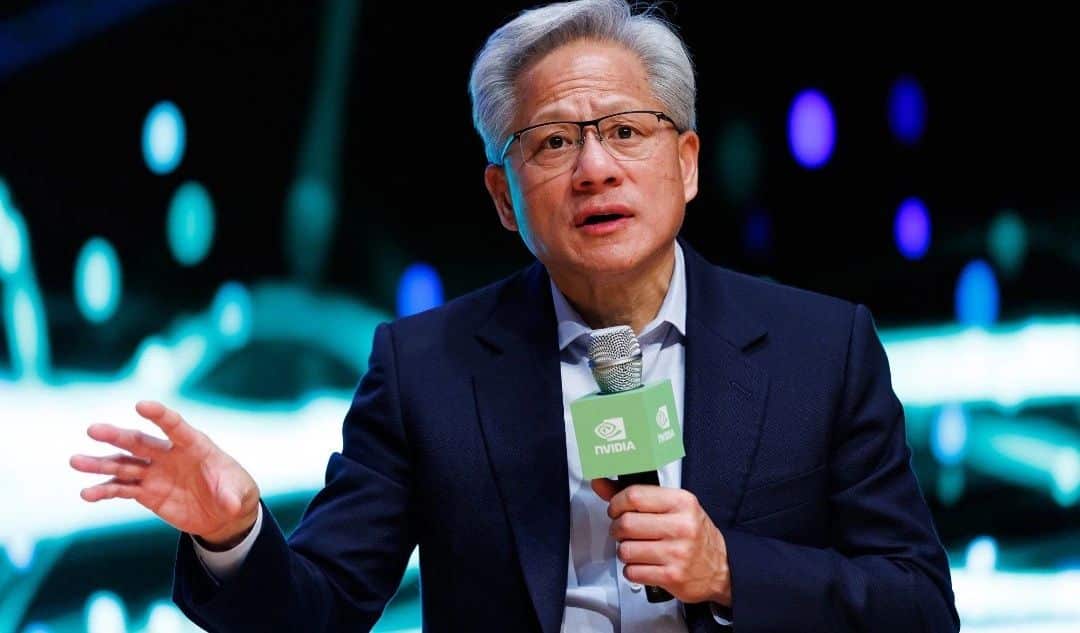
Nvidia stock surges 30% and more during early US trading on Monday, 23 November 2026, following the company’s announcement that co-founder Jensen Huang had been reinstated as president, chief executive officer and a member of its board of directors. The decision reversed his departure earlier this month and triggered a substantial rebound in the semiconductor company’s shares. The rally added approximately US$1 trillion to Nvidia’s market capitalisation at one stage, marking a significant turnaround after weeks of declining share prices. The development also helped lift the broader technology market, where investors had become increasingly concerned about valuations and uncertainty surrounding the artificial intelligence industry.
The announcement came at a particularly important moment for Nvidia, which remains central to the global expansion of AI infrastructure. Despite reporting strong quarterly financial results only days earlier, the company had experienced considerable selling pressure as investors reassessed its leadership and future direction. Monday’s reaction suggests that restoring confidence in the company’s management was an important factor in investor sentiment. However, the rebound does not mean every concern affecting Nvidia’s valuation has disappeared.
What Did Nvidia Announce About Jensen Huang’s Return?
In its official statement released on 23 November, Nvidia confirmed that its board had unanimously approved Huang’s immediate reinstatement. The board said it had reached its decision following discussions with Huang and was satisfied with his ability to continue leading the company. Harvey C. Jones will remain board chair, while Colette Kress, who served as interim CEO, will continue as executive vice president and chief financial officer.
Huang’s return restores the leadership structure associated with Nvidia’s transformation into one of the world’s most influential technology businesses. As co-founder and long-serving chief executive, he has been closely involved in the company’s development of graphics processors, data centre technologies and AI computing platforms. His reinstatement provides continuity at a time when major technology companies are making substantial investments in AI infrastructure. Nvidia also confirmed that its independent board investigation and additional compliance initiatives would continue.
How Much Did Nvidia Stock Gain Following the Announcement?
Nvidia shares jumped approximately 33% during early Monday trading, recovering a substantial portion of their recent losses. The stock had been under pressure during November, with uncertainty surrounding the company’s leadership adding to broader concerns about AI-related investments. Shares had already shown signs of recovery in premarket trading before the official announcement, but the confirmation was followed by a considerably stronger rally.
According to Reuters’ market coverage on 23 November, the rally extended beyond Nvidia, with the Nasdaq Composite gaining more than 6% and the S&P 500 rising approximately 5% during the session. Other technology and semiconductor businesses also attracted renewed buying interest. These movements reflect market prices during trading rather than final closing figures. Nevertheless, the scale of the reaction demonstrates the significance investors attach to Nvidia’s leadership.
Why Can One CEO’s Return Influence Such a Large Market?
Nvidia occupies an unusually important position in the AI economy because its processors and computing systems support many of the infrastructure projects being developed by major cloud providers and technology companies. Its business relationships extend across data centres, advanced computing, enterprise AI and software development. Consequently, uncertainty surrounding Nvidia can influence expectations for businesses that depend on its technology or participate in the wider AI supply chain.
Huang’s return appears to have reduced some of the immediate uncertainty investors associated with the leadership transition. However, the rebound should not be interpreted as evidence that the company’s underlying earnings or future revenue suddenly increased by a third. Share prices reflect expectations about future performance, management, risk and investor confidence. A rapid change in those expectations can produce significant market movements even without a comparable change in current business operations.
Were Nvidia’s Financial Results Already Strong Before the Rally?
Nvidia’s latest financial performance provides important context for understanding the market reaction. On 17 November, the company reported third-quarter fiscal 2027 revenue of US$115.8 billion, representing a 103% increase compared with the corresponding period a year earlier. Data centre revenue reached US$107.6 billion, an increase of 110%, reflecting continued demand for AI computing infrastructure.
The company also reported quarterly net income of US$65.3 billion and projected approximately US$130 billion in revenue for the following quarter, subject to its stated forecast range. These figures indicate that Nvidia’s operating growth remained substantial despite the recent decline in its share price. The disconnect between strong financial results and falling market valuations illustrates how investor expectations can shift even when a company’s current earnings remain robust.
What Does Nvidia’s Rebound Mean for the Wider AI Investment Market?
The wider market response indicates that Nvidia’s leadership uncertainty had become one of several concerns influencing AI-related investments. Companies supplying computing infrastructure, developing AI applications and financing data centre expansion are increasingly interconnected. When confidence in a major technology supplier weakens, investors may reassess businesses with similar exposure.
The rebound also comes amid wider questions about the cost of developing and operating advanced AI systems. Lanka Biz News previously examined these pressures in its analysis of Anthropic’s financial performance and the economics of AI expansion. Strong demand for AI computing does not automatically guarantee that every business investing in the technology will achieve profitable returns. Nvidia’s rally improves the immediate market outlook, but the financial sustainability of the broader AI industry remains an important consideration.
Nvidia Stock Surges 30% Mean, Investor Confidence Has Fully Returned?
The Nvidia stock surge demonstrates how quickly sentiment can improve when a major source of uncertainty appears to ease. Nevertheless, a single trading session cannot establish whether the company has entered a sustained recovery. Investors will continue evaluating future earnings, demand for computing infrastructure, competition, corporate governance and broader market conditions.
Longer-term uncertainty also extends to the development and oversight of increasingly powerful AI technologies. As Lanka Biz News recently examined in its article on AI development limits and emerging industry standards, the next phase of AI expansion may involve additional operational and regulatory considerations. For companies such as Nvidia, future market valuations will depend on the strength of demand for their technology and the financial returns that customers can generate from AI investments.
Jensen Huang’s return has delivered an immediate improvement in Nvidia’s market position, but the greater business significance lies in what the rally reveals about investor confidence. A company can report exceptional revenue growth and still experience substantial market losses when uncertainty increases. Monday’s rebound illustrates the opposite reaction: when confidence improves, investors can rapidly reassess the value they are willing to place on future earnings. Whether those gains endure will depend on Nvidia’s continued performance and the wider direction of the AI economy.
Editorial Disclaimer:
This article is based on Nvidia’s official announcement, financial disclosures and market reporting available on 23 November 2026. Stock price movements, percentage gains and market capitalisation estimates refer to intraday trading and may change before the market closes. The analysis is provided for business information and does not constitute investment advice.