EU India FTA Sri Lanka concerns have moved from a theoretical trade-policy question into a practical business issue. On 24 August, the Export Development Board confirmed that it had discussed the potential impact with consultants engaged by the European Commission, with particular attention given to apparel, preferential market access, rules of origin and the use of Indian inputs in Sri Lankan production.
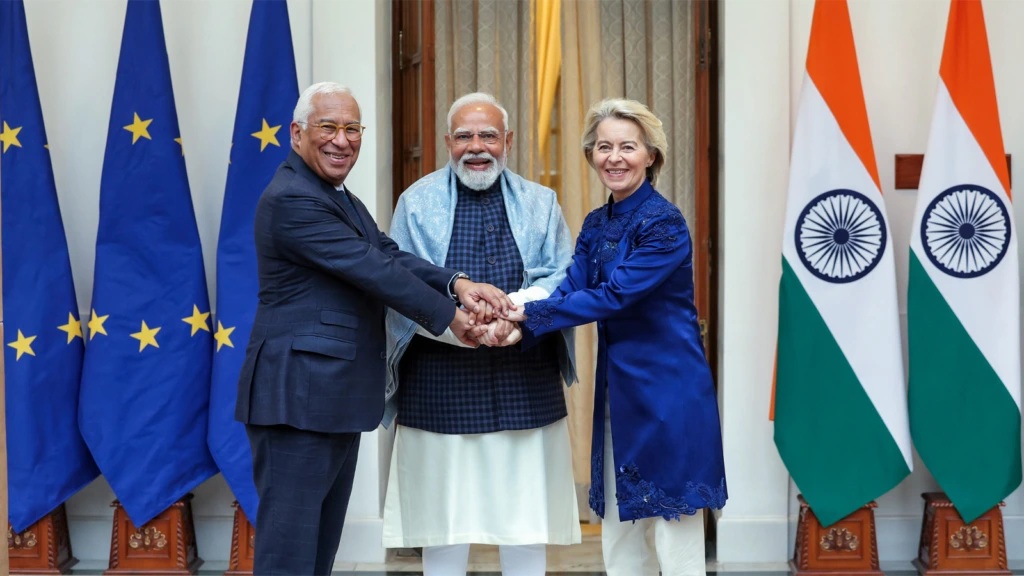
The timing matters because nothing has changed at the border yet. Negotiations between the European Union and India concluded on 27 January 2026, but the agreement still has to complete legal review, signature and the necessary internal procedures before it can enter into force. For Sri Lankan businesses, this is therefore not a story about competitiveness already being lost. It is about using the period before implementation to understand where the commercial pressure will emerge and preparing for it while there is still time.
EU India FTA Sri Lanka: The Real Risk Is Preference Erosion
Sri Lanka’s position in the European market remains valuable. The EU is the country’s second-largest merchandise export destination after the United States and accounts for approximately 24% of Sri Lanka’s merchandise exports, according to the EDB. Germany, Italy, the Netherlands, France and Belgium were among the important EU markets recording stronger Sri Lankan exports during 2025.
Sri Lanka also benefits from the EU’s GSP+ arrangement, which provides zero-duty access for a wide range of eligible products when exporters satisfy the relevant origin requirements. That advantage is not being removed because India concluded an FTA. What changes is the relative position of Sri Lanka when an economy with India’s production scale begins receiving substantially better access to the same European market.
India’s agreement covers a very large share of bilateral trade, and official EU and Indian documentation shows that labour-intensive sectors such as textiles and apparel, leather, footwear, marine products, chemicals, rubber and plastics, sports goods, toys and gems and jewellery stand to gain substantially improved access. India’s Department of Commerce says more than 90% of its current export value to the EU is scheduled for immediate duty elimination when the agreement enters into force, including important labour-intensive industries.
For Sri Lanka, this is better described as erosion of a tariff advantage than the creation of a new barrier. Sri Lankan products do not suddenly become more expensive because of the FTA. Instead, Indian products that previously carried a greater tariff burden could become more competitive alongside them.
Apparel Is Where the Issue Becomes Most Immediate
The apparel discussion deserves particular attention because this is where small changes in landed cost can influence large sourcing decisions. Sri Lanka has spent years building a reputation around ethical manufacturing, technical capability, compliance, lingerie, activewear, product development and established relationships with European brands. Those strengths do not disappear when a competitor receives a tariff concession, but price comparisons inevitably become tighter.
India also brings advantages that Sri Lanka cannot realistically replicate through scale alone. It has a large domestic textile base, considerable cotton and yarn production, a much bigger manufacturing workforce and the ability to integrate several stages of the textile value chain domestically. Once tariff disadvantages are reduced, some European buyers may have stronger reasons to consider Indian sourcing in categories where quality, lead time and specifications are comparable.
That does not mean orders will automatically move from Sri Lanka to India. Apparel sourcing decisions involve compliance history, product complexity, reliability, capacity, production speed and the cost of changing suppliers. The more realistic business risk is that Indian tariff improvements strengthen buyers’ negotiating position and increase margin pressure on products where Sri Lanka has limited differentiation.
The response, therefore, cannot simply be lower prices. Sri Lankan manufacturers need to know which parts of their order books are highly transferable and which depend on technical capability, design input, shorter production runs, sustainability credentials or long-standing buyer integration. The latter categories provide a much stronger defence against tariff-driven competition.
Rules of Origin May Be the More Important Technical Issue
The less visible but potentially important question involves the materials Sri Lankan exporters source from India.
Under the EU’s existing GSP rules, India and Sri Lanka are part of the same Group III regional cumulation framework, together with Bangladesh, Bhutan, Nepal and Pakistan. Subject to the applicable conditions and product-specific rules, regional cumulation can allow materials originating in another country in the group to contribute towards the origin requirements of the final product.
This matters particularly for apparel businesses using Indian yarn, fabrics and other textile inputs. GSP+ tariff benefits depend not simply on manufacturing the final garment in Sri Lanka, but on satisfying detailed origin requirements.
The EDB has therefore correctly identified cumulation as an issue requiring early engagement with the European Union. The concern should not be exaggerated into a claim that Indian materials will immediately stop qualifying when the FTA starts. Under the EU’s new GSP framework, India is expected to continue benefiting from standard GSP treatment for a transitional period after the FTA begins to apply.
The medium-term question is what happens once India’s relationship with the EU is primarily governed by the bilateral FTA rather than GSP. Sri Lanka needs clarity well before that transition affects sourcing decisions. The EDB has already indicated that the Government intends to engage with the EU on appropriate cumulation arrangements involving India, which could be important for preserving regional textile supply chains.
GSP+ Has Become Even More Valuable
The EU–India FTA also increases the commercial importance of Sri Lanka maintaining its own preferential access.
The EU’s revised GSP framework was adopted in 2026 and will apply from 1 January 2027. Existing GSP+ beneficiaries are required to reapply under the new regime because the updated framework introduces additional requirements, including new international conventions and implementation commitments. Existing beneficiaries receive a transition period while completing that process.
Sri Lanka has already indicated through its official engagement with the EU that it intends to seek continued GSP+ access. For exporters, that process should not be regarded as something separate from commercial strategy.
If India is moving towards stronger long-term access through an FTA, Sri Lanka cannot afford uncertainty around a preference that remains central to its European competitiveness. Maintaining GSP+ is therefore not only a foreign-policy or regulatory issue; it is directly connected to factory pricing, buyer confidence and investment planning.
Businesses themselves also have a role. Compliance with labour, environmental, governance and product standards increasingly affects how European buyers select suppliers, regardless of the tariff rate available to a country.
Compliance Could Become Sri Lanka’s Stronger Differentiator
One of the more useful points raised during the EDB discussion is that European market access is increasingly determined by more than customs tariffs. Sustainability, environmental performance, traceability and regulatory compliance continue to become more important in European supply chains.
This gives Sri Lanka an area in which it can compete without trying to match India tonne for tonne or factory for factory. Companies that can provide reliable environmental data, trace inputs, demonstrate responsible labour practices and adapt quickly to changing EU product requirements can become more difficult for buyers to replace.
There should be no assumption that compliance completely cancels out a price difference. In highly standardised products, cost will remain powerful. But in higher-value categories, strong compliance can become part of the commercial product rather than simply another regulatory expense.
That is also where investment decisions matter. Automation, energy efficiency, product development and supply-chain visibility may deliver more lasting competitiveness than using capital simply to reduce prices.
Sri Lanka Should Also Look at India as Part of the Supply Chain
The FTA does not have to be understood only through a Sri Lanka-versus-India lens. The EDB itself has pointed towards the importance of greater integration within regional supply chains.
India’s textile manufacturing base could remain strategically useful to Sri Lanka if the correct origin arrangements are secured. Sri Lankan firms may be able to combine Indian material availability and scale with local strengths in design, specialised manufacturing, responsible production and buyer relationships.
The crucial issue is ensuring that this regional model continues to work within EU origin requirements. If appropriate cumulation can be maintained or developed, the same Indian industry that becomes a stronger competitor could also remain an important input partner.
This is why government-to-government engagement on the technical details is more valuable than simply asking whether Sri Lanka can obtain another tariff concession.
Exporters Should Start Modelling the FTA Before It Starts
The practical preparation now belongs inside company strategy departments, not only trade ministries. Exporters should identify their most important EU tariff lines, compare the current treatment of Sri Lankan and Indian goods and model the position once India’s FTA preferences apply.
Apparel manufacturers should go one step further by identifying exactly how much of each product depends on Indian-origin yarn, fabric or accessories. Businesses that discover a heavy dependence on a particular cumulation arrangement will then know which issue requires policy certainty and how urgently it matters.
The same exercise should extend beyond apparel. Rubber and plastic products, seafood, gems and jewellery and other sectors identified by the EDB may encounter stronger Indian competition, but the effect will vary considerably by product. Some Sri Lankan exporters may face little change, while others could see a meaningful reduction in their existing preference margin.
That level of product-by-product analysis is more useful than broad predictions about whether the FTA will be “good” or “bad” for Sri Lanka.
The Preparation Window Is the Opportunity
The EU–India FTA is a significant change in the regional trade landscape, but it has not yet changed Sri Lanka’s market access. That distinction should shape the response.
Sri Lanka’s strongest position is to protect what already works: continued GSP+ access, workable rules of origin, reliable compliance and established buyer relationships. At the same time, exporters need to move further into products where technical capability, sustainability, innovation and quality matter enough to reduce dependence on tariff advantages alone.
The EDB’s decision to engage with European Commission-appointed consultants before the agreement becomes operational is therefore timely. The most important issues, particularly cumulation and apparel competitiveness are being identified while the final trade environment can still be studied and preparations made.
India gaining better EU access does not mean Sri Lanka has lost the European market. It means a preference Sri Lanka has relied upon will become less exclusive.
The businesses that understand that distinction early will be in a much stronger position when the agreement finally takes effect.
For further business and trade analysis, visit Lanka Biz News.
This article is for educational, business analysis and news purposes only. The EU–India FTA had not entered into force at the time of writing, and its provisions will apply only after the required legal and ratification procedures are completed.