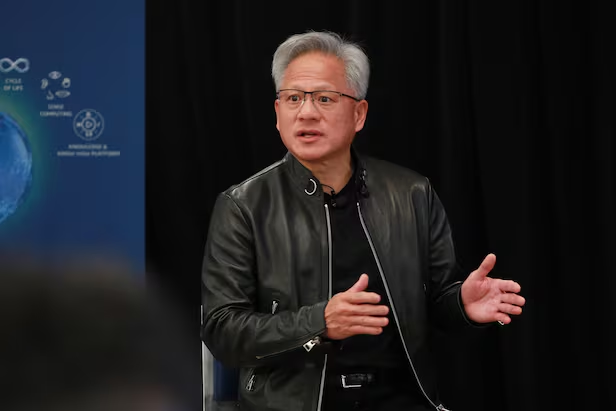
Open-weight AI models have moved to the centre of a major technology policy dispute after Nvidia chief executive Jensen Huang used his first post on X to promote a joint industry statement defending their role in innovation, competition, cybersecurity and national technological sovereignty.
The statement, titled Open Weights and American AI Leadership, was released on 24 July 2026 with the backing of companies spanning semiconductors, cloud infrastructure, model development, cybersecurity, enterprise software and venture capital.
Its central message is direct: the future of American artificial intelligence should not depend exclusively on a small number of closed frontier systems. Instead, policymakers should preserve an ecosystem in which organisations can download, adapt, inspect and operate advanced models on infrastructure they control.
The campaign quickly attracted support from Microsoft chief executive Satya Nadella, Google and Alphabet chief executive Sundar Pichai, Meta chief executive Mark Zuckerberg, OpenAI chief executive Sam Altman and Elon Musk.
However, one important frontier-model developer remains absent: Anthropic.
That absence does not prove that Anthropic opposes every form of open AI. It does, however, expose one of the most consequential divisions developing within the technology industry: whether increasingly capable AI models can remain broadly downloadable without creating unacceptable cybersecurity, intellectual-property and national-security risks.
Open-Weight AI Models Are Not Exactly Open-Source AI
The terminology matters.
Open-weight AI models make their trained numerical parameters, the model weights available for users to download and operate. This can allow developers to fine-tune the model, inspect its behaviour, deploy it privately and build specialised products without depending continuously on the original provider’s application programming interface.
That does not necessarily mean the entire system is open source.
A model provider may release the weights while withholding training data, data-cleaning procedures, complete source code or detailed information about the training process. The licence may also restrict certain commercial or high-risk uses.
A genuinely open-source AI system would generally require broader transparency and freedoms than the publication of weights alone.
The distinction is important because the joint statement is defending open weights, not demanding that every frontier company disclose its datasets, algorithms and complete development process.
This creates space for a mixed market in which proprietary systems coexist with models that businesses can download and operate themselves.
Also in Explained | How Elon Musk’s Early Faith in OpenAI Sparked a Decade-Long NVIDIA Partnership and Why It’s Stronger Than Ever
Why Jensen Huang’s Intervention Matters
Huang’s involvement gives the campaign unusual commercial and political weight.
Nvidia supplies the computing infrastructure used to train and run models across the industry. It can benefit from demand generated by both closed laboratories and a much wider ecosystem of businesses deploying downloadable models.
His argument is therefore both philosophical and commercially rational.
A market dominated by a few closed-model providers concentrates AI spending among a limited number of large platforms. A market containing thousands of specialised open-weight deployments can expand demand across cloud providers, private data centres, sovereign AI infrastructure, workstations and edge devices.
Huang’s position is that the world requires both frontier closed systems and frontier open ones.
This is not an argument that every powerful model should be released without controls. It is a warning that eliminating the open side of the market would reduce competition, slow adoption and leave businesses dependent on a small number of providers.
For Nvidia, a plural model ecosystem means more experimentation, more inference workloads and potentially more demand for computing equipment.
Its commercial interests and its policy argument therefore point in the same direction.
Satya Nadella, Sundar Pichai and Other Leaders Join the Push
Satya Nadella described open-weight models as essential to a healthy AI ecosystem.
Microsoft’s participation is notable because its business is not limited to one model strategy. It distributes proprietary systems while also offering open models through Azure, GitHub and its broader developer ecosystem.
Supporting open weights allows Microsoft to position its cloud infrastructure as the place where businesses can deploy whichever model best suits their requirements.
Meta also signed the statement, reinforcing its longstanding argument that open models can accelerate adoption and strengthen the surrounding developer ecosystem.
Mark Zuckerberg publicly described open source as an important force for innovation and competition.
Sundar Pichai said he was happy to support the initiative on behalf of Google, pointing to Google DeepMind’s Gemma family of open-weight models. Google itself was not listed as a corporate signatory on the public page as of 25 July, making Pichai’s direct endorsement particularly significant.
Elon Musk gave Huang’s position his full support, even though neither xAI nor his other companies appeared on the signatory list.
Sam Altman also backed the principle that the United States should succeed in both proprietary and open models. OpenAI was missing from the initial 25-name version attached to Huang’s post but was subsequently added to the publicly hosted signatory list.
The original letter displayed 25 organisations. By 25 July, Microsoft’s live version listed 35 signatories, including OpenAI, Cisco, Cohere, GitHub, DoorDash, Fireworks AI, Palo Alto Networks and several other additions.
The expanding list shows that the initiative is developing into a broad technology-industry coalition rather than remaining an Nvidia-led campaign.
What the Coalition Is Asking Policymakers to Do
The statement is not simply a public celebration of open technology. It is a policy intervention aimed at Washington.
Its authors want regulators to avoid broad restrictions that treat downloadable models as inherently more dangerous than closed ones.
They argue that policy should focus on demonstrated risks and unlawful conduct rather than the technical distribution model itself.
This principle becomes particularly important in the section addressing model distillation.
Distillation is a process through which one model’s outputs can be used to train or improve another model. It is widely employed for model compression, evaluation, capability transfer and the creation of smaller specialised systems.
However, distillation can also become controversial when companies obtain large volumes of outputs from a proprietary model in ways that may breach contractual restrictions or attempt to reproduce protected capabilities.
The coalition warns policymakers not to classify all distillation as theft. Instead, it supports targeted legal and commercial action against unlawful extraction while preserving legitimate model-development techniques.
That language places the letter directly within the current debate over Chinese open-weight models and allegations that some overseas laboratories may have used American proprietary systems to accelerate their development.
The signatories are effectively arguing that alleged misconduct by particular companies should not become the justification for restricting the entire open-model ecosystem.
The Business Case: Cost, Control and Vendor Independence
For businesses, the strongest argument for open weights is control.
A company using only a closed AI service depends on the provider’s pricing, usage limits, product decisions, availability and data-governance arrangements.
The provider may change its model, withdraw a version, alter the terms of service or increase prices. Migrating complex workflows to another provider can then become expensive.
An open-weight model can be hosted privately, modified for a particular task and retained even when the original developer changes its commercial strategy.
This can be especially valuable for banks, hospitals, manufacturers, government institutions and companies handling sensitive intellectual property.
Open weights can also lower the cost of high-volume, repetitive tasks. Businesses do not require the most powerful frontier model for every customer query, document classification or internal search.
A smaller specialised model may deliver sufficient performance at a substantially lower operating cost.
For businesses in emerging markets, the model can also be adapted for local languages, sector-specific terminology and national regulatory requirements without waiting for a global provider to prioritise those needs.
This makes the debate relevant far beyond the United States. It affects which countries and companies can build their own AI capabilities rather than merely renting intelligence from a handful of foreign platforms.
Also in Explained | Is the 2026 AI-Driven Memory Chip Crisis Making Everyday Gadgets Unaffordable?
The Safety Argument Is More Complicated
The coalition does not deny that open-weight models create risks.
Once weights are publicly released, the original developer may no longer be able to withdraw every copy, enforce centralised safeguards or prevent modified versions from circulating.
Users may remove refusal systems, change the model’s behaviour or deploy it in environments that cannot be monitored by the developer.
The signatories respond that closed systems are not automatically safe. They can be breached, misused or affected by vulnerabilities that outside researchers cannot inspect.
Open models allow more researchers, cybersecurity teams and independent evaluators to test behaviour, identify weaknesses and build safeguards.
Both arguments contain legitimate concerns.
Openness can distribute defensive capability and improve scrutiny. It can also distribute offensive capability and make central intervention difficult.
The policy challenge is therefore not to label one architecture safe and the other dangerous. It is to determine which capabilities require additional controls, irrespective of whether the model is open or closed.
Why Anthropic’s Absence Is Important
Anthropic remains the most conspicuous major AI company missing from the joint statement.
The company had not provided a public explanation for its absence as of 25 July. It would therefore be inaccurate to claim that Anthropic rejected the letter or was formally invited and refused to sign it.
Its published policy positions nevertheless help explain why the company may approach this debate differently.
Anthropic has repeatedly emphasised the risks created when highly capable model weights leave the original developer’s control. Its Responsible Scaling Policy applies stronger security protections as models approach capabilities associated with major cyber, biological or other catastrophic risks.
The company has also argued that once powerful open weights are released, safeguards can be removed and the models may become available to state and non-state actors.
Anthropic has been particularly outspoken about what it calls distillation attacks, arguing that foreign laboratories can use large-scale extraction of Claude outputs to bypass controls and reproduce valuable capabilities.
This creates a direct tension with the coalition’s effort to protect distillation as a legitimate and widely used development technique.
The disagreement is not necessarily over whether lawful distillation exists. It concerns where legitimate learning ends and commercial or strategic appropriation begins—and whether existing legal mechanisms are sufficient to police that boundary.
Anthropic has previously stated that frontier regulation should focus on empirically measured risk rather than automatically favouring closed or open models. Its absence should therefore not be simplified into an “anti-open-source” position.
Instead, it reflects a more cautious view of releasing increasingly powerful underlying capabilities.
A Commercial Coalition as Well as a Policy Coalition
The companies supporting the statement have substantial commercial reasons to preserve open weights.
Chipmakers benefit from broader computing demand. Cloud providers benefit when customers deploy more models. Enterprise software companies can build specialised products without depending on one laboratory. Venture capital firms benefit from lower barriers for startups. Cybersecurity companies gain access to systems they can inspect and adapt.
Meta and Mistral have made open models part of their competitive identity. Hugging Face and the Linux Foundation depend on open development ecosystems. Microsoft, IBM and Dell can sell infrastructure and services across multiple model families.
This does not invalidate their policy position.
It shows that the debate is also about the future structure of the AI market: whether value will be concentrated primarily within a few frontier laboratories or distributed across chips, clouds, applications, enterprise systems and specialised models.
The Real Choice Is Not Fully Open or Fully Closed
The strongest part of Huang’s argument is its rejection of a false binary.
Some tasks will require highly controlled frontier systems with central monitoring and carefully maintained safeguards. Others will benefit from efficient models that businesses can own, adapt and run privately.
The question for policymakers is whether they can distinguish between capability-based risk and distribution-based fear.
Blanket restrictions could protect a small number of established providers, weaken competition and encourage developers in other countries to define the open-model ecosystem.
An absence of meaningful controls, however, could allow highly dangerous capabilities to circulate without accountability.
The industry coalition is not asking for an unregulated market. It is asking for targeted enforcement rather than sweeping prohibition.
Jensen Huang’s intervention has turned that position into one of the defining AI policy arguments of 2026. The support from Nadella, Pichai, Zuckerberg, Altman and Musk shows that the case for open weights extends across companies with very different business models.
Anthropic’s absence ensures that the debate is not settled.
It highlights the unresolved question at the heart of modern AI policy: whether technological sovereignty and broad innovation can be expanded without releasing capabilities that society may later find impossible to control.
The full industry statement presents the coalition’s case for keeping both open and closed models at the frontier.
This article is for educational, technology analysis and news purposes only.