Last week we examined how rural tourism can deliver deeper, more inclusive economic benefits to Sri Lanka. This week, a sudden global shock demands urgent attention: the escalating conflict in the Middle East has disrupted one of the island’s most critical aviation gateways. With Dubai serving as the “primary transit hub” for a significant share of international visitors, the airspace closures and flight cancellations since late February 2026 are already triggering booking losses and threatening momentum toward the national target of 3 million tourist arrivals this year.
Sri Lanka’s tourism sector recorded a record 2.36 million arrivals in 2025, generating approximately US$3.22 billion in revenue. The first two months of 2026 showed continued strength, with January alone delivering 277,327 visitors, a 9.7% increase year-on-year. Yet the March peak period now faces real headwinds. If the disruptions persist beyond the initial week, the country risks falling short of monthly targets and, by extension, the full-year ambition that underpins post-cyclone economic recovery.
Also in Explained | What is Rural Tourism and How Can Sri Lanka Improve It for Greater Impact?
Understanding the Middle East Conflict’s Impact on Global Aviation
On 28 February 2026, joint US-Israeli strikes on Iran triggered immediate retaliation, including missile and drone attacks that struck targets across the Gulf. Airports in Dubai, Abu Dhabi and Doha sustained damage or operational halts. Airspace over the UAE, Qatar, Bahrain, Kuwait and parts of Saudi Arabia was closed or severely restricted for several days, the most severe disruption to international aviation since the COVID-19 pandemic.
Dubai International Airport, the world’s busiest for international passengers and Sri Lanka’s dominant transit point, saw the majority of flights cancelled through 2 March, with only limited operations resuming on the evening of 2 March. Emirates, Flydubai, Qatar Airways and Etihad carriers that collectively handle a substantial portion of traffic to Colombo, suspended or drastically scaled back services. The ripple effect reached Europe, North America and Asia, stranding hundreds of thousands of passengers worldwide, including thousands en route to or from Sri Lanka.
Sri Lanka’s Critical Dependence on the Dubai Transit Hub
Data from the Sri Lanka Tourism Development Authority (SLTDA) for January 2026 reveals the scale of exposure. Dubai accounted for 13% of all arrival connections, Doha 10% and Abu Dhabi 7% meaning roughly 30% of international visitors transit through these three Gulf hubs. Among the top airlines serving Sri Lanka that month, Emirates contributed 9%, Etihad 6% and Flydubai 4% of passenger movements.
Europe remains the largest source market at 57.4% of January arrivals. Many of these high-spending visitors from the UK, Germany, France, Russia and Eastern Europe rely on seamless one-stop journeys via Dubai or Doha. Direct long-haul services exist but remain limited in frequency and capacity. When the Gulf corridor collapses, alternative routings via Istanbul, Singapore or direct charters become more expensive and less convenient, leading to immediate cancellations.
SriLankan Airlines itself cancelled ten scheduled flights to Dubai, Doha, Riyadh, Dammam and Kuwait between 1 and 3 March 2026 for safety reasons. While the national carrier has maintained core European and Asian routes where possible, the loss of connecting traffic is already evident in reduced forward bookings for March and April.
Quantifying the Potential Losses for March and Beyond
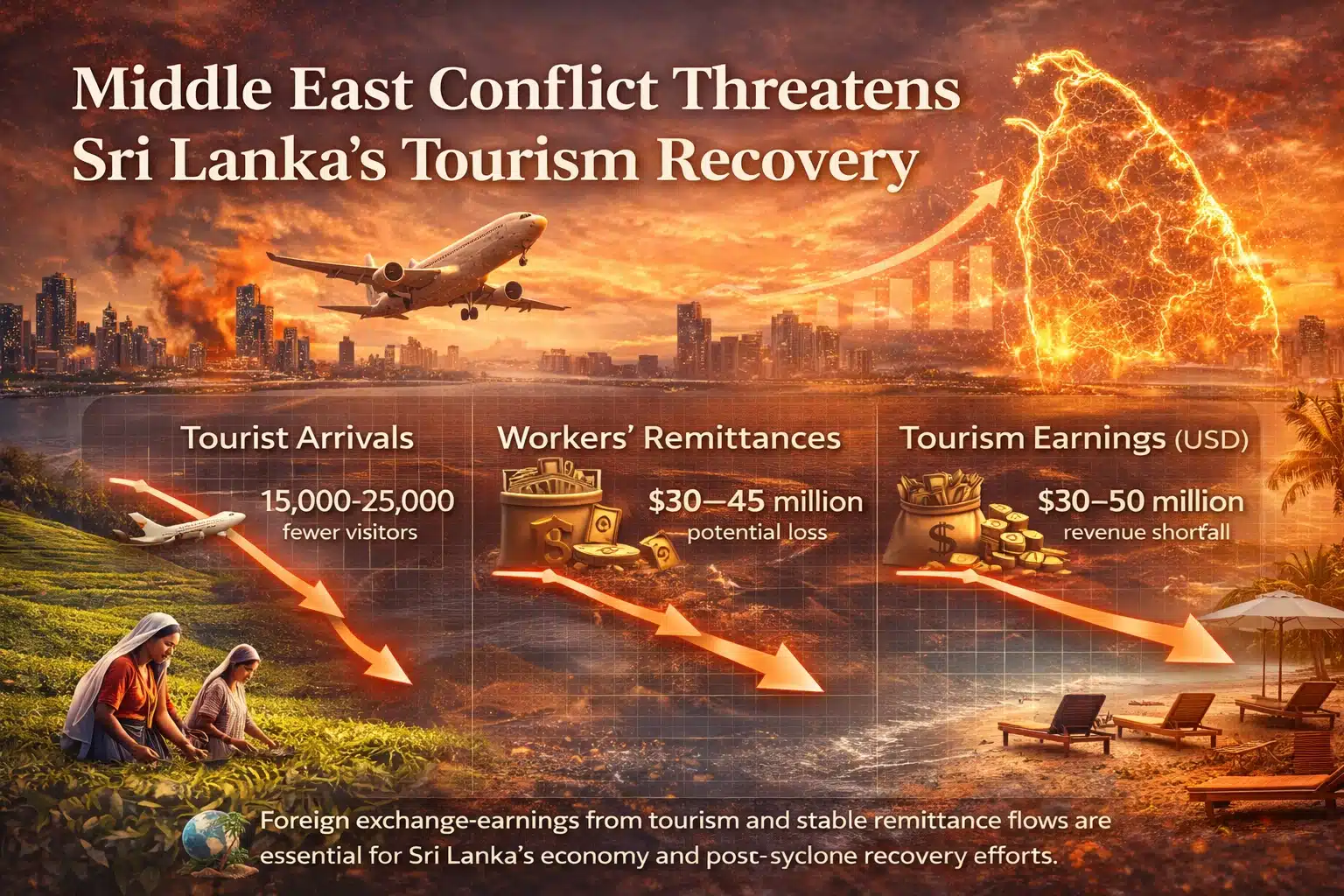
March historically ranks among Sri Lanka’s stronger months, benefiting from European winter escapes and shoulder-season appeal in the Cultural Triangle and beaches. Industry estimates suggest that, without intervention, the current disruptions could result in 15,000–25,000 fewer arrivals during March alone if the situation drags into mid-month. This represents a potential revenue shortfall of US$30–50 million at current average spend levels.
The impact extends beyond volume. High-value European and North American markets precisely those most affected by the rerouting chaos contribute disproportionately to per-visitor spending. Meanwhile, the small but growing Middle Eastern source market (only 0.9% of January arrivals) faces its own outbound constraints, though Sri Lanka has been actively courting UAE and Saudi visitors through targeted promotions and visa-on-arrival expansions.
The broader economy feels the pressure quickly. Tourism supports over 400,000 direct and indirect jobs, many in rural and coastal communities. Foreign exchange earnings from the sector help stabilise the rupee and fund essential imports. A prolonged slowdown would compound challenges from the late-2025 cyclone recovery effort.
Lessons from Past Crises: Resilience Through Diversification
Sri Lanka has navigated major shocks before. Following the 2019 Easter attacks, arrivals plummeted; yet by 2023 the sector had rebounded through aggressive marketing, safety certification and product diversification. During the 2022 economic crisis, targeted campaigns in resilient markets such as India and Russia delivered quick wins.
Internationally, comparable destinations offer useful models. When Russian airspace closures in 2022 forced European carriers to reroute, Thailand and Vietnam accelerated direct flights from secondary European cities and invested in Middle East alternatives via Istanbul and Doha recovery packages. Maldives successfully shifted marketing emphasis to direct charter programmes from Germany and the UK during the same period, mitigating Gulf dependency.
The common thread in successful recoveries: rapid communication of safety credentials, flexible visa policies and accelerated development of non-traditional products.
Practical Strategies to Protect and Strengthen Sri Lanka Tourism
To limit short-term damage and emerge stronger, stakeholders must act on multiple fronts:
1. Immediate Crisis Response
The government has already granted temporary 14-day visa extensions to affected tourists stranded in Colombo or planning short extensions. SLTDA and SriLankan Airlines should maintain daily updated hotlines and rebooking incentives. A joint “Sri Lanka is Open and Safe” digital campaign, highlighting zero direct impact from the conflict, can reassure hesitant travellers.
2. Air Connectivity Diversification
Fast-track negotiations for additional direct or codeshare services via Istanbul (Turkish Airlines), Singapore (Singapore Airlines) and enhanced Indian hubs. Offer landing-fee waivers and marketing support to carriers adding Colombo rotations. Explore seasonal direct charters from key European cities.
3. Product and Market Repositioning
Accelerate promotion of rural tourism experiences discussed last week homestays, Pekoe Trail extensions, village agritourism as authentic, low-density alternatives that appeal to safety-conscious, experience-seeking travellers. Package these with beach or cultural add-ons to increase length of stay and spend.
4. Middle East Source Market Acceleration
Capitalise on the relatively smaller disruption for GCC outbound travel once flights resume. Double down on the existing target of 100,000 UAE visitors annually through roadshows, influencer campaigns and direct flight incentives with Emirates and flydubai.
5. Policy and Investment Support
Introduce targeted fiscal incentives for hotels and operators demonstrating strong local supply chains. Fast-track sustainable certification under the National Sustainable Tourism Certification scheme to build long-term resilience. Allocate emergency marketing funds from the Tourism Development Levy.
6. Data-Driven Monitoring
Establish a daily arrivals dashboard with SLTDA, Civil Aviation Authority and immigration to track real-time impact and adjust tactics weekly.
If implemented swiftly, these measures can contain March losses to single digits and position Sri Lanka to still achieve or exceed the 3 million target by capitalising on pent-up demand once Gulf operations normalise.
Turning Challenge into Opportunity for a More Resilient Sector
The Middle East conflict is a painful reminder of external vulnerabilities, but it also underscores the strategic importance of the balanced, community-focused tourism model outlined last week. By reducing over-reliance on any single transit corridor and deepening authentic rural and sustainable offerings, Sri Lanka can transform this short-term setback into a catalyst for structural strengthening.
The foundations are already in place: record 2025 performance, strong early-2026 momentum, and a clear national target. With coordinated action across government, airlines, operators and communities, the island can safeguard this year’s goals while building a tourism industry that is more diversified, inclusive and shock-resistant for the decade ahead.
Subsequent articles in this series will examine specific route diversification opportunities, digital marketing tactics during crises, and investment priorities to support long-term growth.
Also in Explained | Sri Lanka’s External Sector Records Strong Performance in January 2026