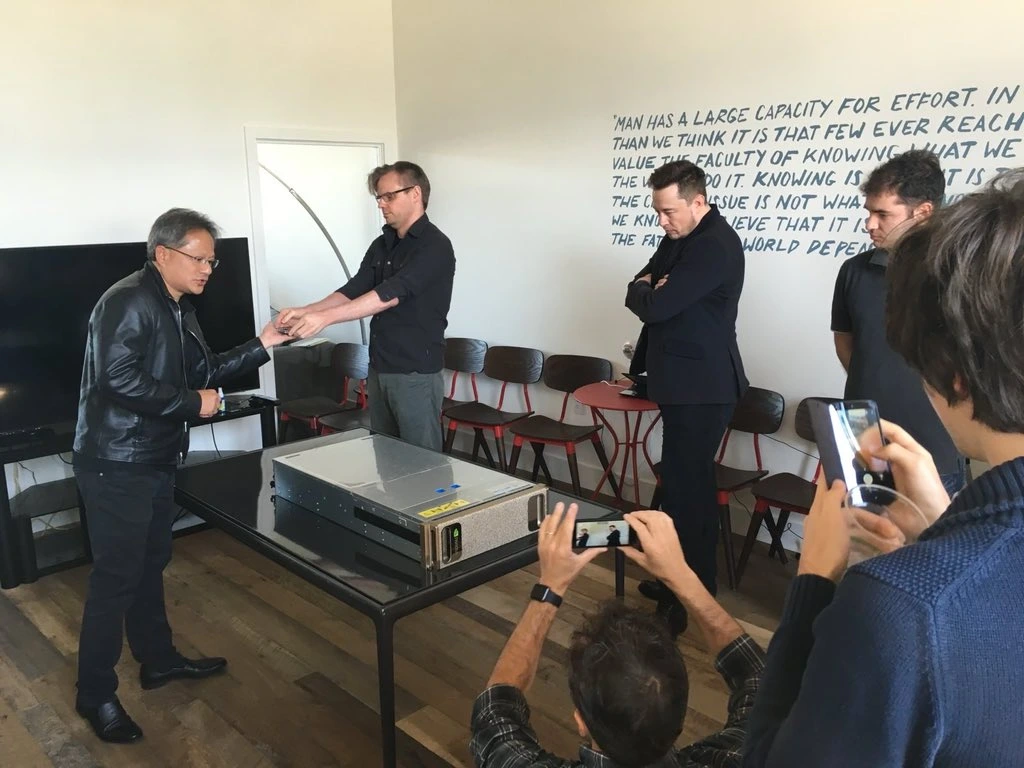
In a recent interview clip that resurfaced in February 2026, NVIDIA CEO Jensen Huang shared a captivating anecdote from the dawn of modern AI: Elon Musk, through the fledgling OpenAI, became the very first customer for NVIDIA’s groundbreaking DGX-1 AI supercomputer in 2016. At a time when no one else placed an order for the revolutionary system, Musk’s belief in AI’s potential aligned with OpenAI’s original mission as an open-source, non-profit research initiative led Huang to personally deliver the unit to a modest San Francisco office housing a small team of pioneers, including Ilya Sutskever and Pieter Abbeel.
This story highlights Musk’s prescient vision during OpenAI’s early days, when it was committed to openly advancing artificial general intelligence for humanity’s benefit. A decade later, despite Musk’s departure from OpenAI in 2018, the technological alliance between NVIDIA and Musk’s ventures spanning Tesla, xAI, and beyond has not only endured but flourished. This analysis explores the historical details, Musk’s foundational role, and the evolving, mutually beneficial partnership driving AI innovation today.
Also in Explained | Is the 2026 AI-Driven Memory Chip Crisis Making Everyday Gadgets Unaffordable?
OpenAI’s Open-Source Vision and Elon Musk’s Decisive Backing
OpenAI was launched in December 2015 as a non-profit organization dedicated to developing AGI safely and transparently, with a strong emphasis on open-source research to prevent concentration of power among tech giants. Musk co-founded the initiative alongside Sam Altman, Greg Brockman, and others, pledging significant personal funding reportedly over $100 million initially and championing its mission to counterbalance closed AI development at companies like Google.
In 2016, NVIDIA unveiled the DGX-1, the world’s first purpose-built AI supercomputer, powered by eight Pascal GPUs and designed to accelerate deep learning. Huang has recounted that demand was virtually nonexistent upon announcement, no purchase orders except one. Musk, attending an early event, expressed interest on behalf of OpenAI, exciting Huang until he learned it was a non-profit. Undeterred, Huang personally boxed and delivered the first unit to OpenAI’s cramped headquarters, kickstarting what would become a transformative era in AI hardware adoption.
This act symbolized Musk’s early conviction: when the industry dismissed advanced AI as speculative, he invested resources in infrastructure that enabled breakthroughs like GPT models. OpenAI’s open-source ethos at the time, releasing tools and research freely aligned with Musk’s concerns about AI risks, making the DGX-1 acquisition a pivotal bet on democratized intelligence.
Transition and Evolution – From OpenAI to xAI
Musk stepped away from OpenAI in 2018 amid disagreements over its shift toward a capped-profit model and closer ties with Microsoft. He later founded xAI in 2023 to “understand the true nature of the universe,” reviving an open, truth-seeking approach with Grok models partially open-sourced.
The NVIDIA connection, however, remained unbroken. Tesla has long relied on NVIDIA GPUs for autonomous driving training, while xAI’s rapid ascent building the Colossus supercluster with over 100,000 NVIDIA H100 GPUs in just 19 days, earned high praise from Huang, who called Musk “superhuman” for the feat.
Milestones in NVIDIA-Musk Collaboration
Far from fading, ties between NVIDIA and Musk’s ecosystem have deepened, fueled by shared ambitions in scaling AI.
- Hardware Supply and Supercomputing Dominance
xAI’s Colossus, expanded multiple times in 2025-2026, relies exclusively on NVIDIA technology. Tesla’s Dojo complements but often incorporates NVIDIA chips, with reports of diverted shipments prioritizing xAI and X platforms. - Personal Gestures and Symbolic Continuity
In October 2025, Huang hand-delivered a DGX Spark the latest personal AI supercomputer to Musk at Starbase, echoing the 2016 OpenAI delivery and marking nine years of collaboration. - Investments and Strategic Alignments
NVIDIA has participated in xAI funding rounds, including potential multi-billion commitments. Joint projects include data center developments, with xAI as a key customer for NVIDIA-backed facilities. - Mutual Endorsements and Innovation Push
Huang frequently lauds Musk’s execution speed, while xAI leverages NVIDIA’s latest architectures (Blackwell, Rubin) for Grok advancements. Tesla’s AI for Full Self-Driving and Optimus robots benefits similarly. - Broader Ecosystem Impact
The partnership extends to integrated efforts, such as AI-enhanced SpaceX operations and potential orbital computing, blending NVIDIA’s hardware prowess with Musk’s vertical integration.
This ongoing synergy rooted in 2016’s foundational trust positions both as leaders in the AI arms race, with NVIDIA supplying the “picks and shovels” and Musk deploying them at unprecedented scale.
Why This Enduring Alliance Benefits the AI Landscape
The NVIDIA-Musk collaboration yields substantial strengths.
- Accelerated Innovation Cycles
Musk’s aggressive deployment pushes NVIDIA to iterate faster, benefiting the entire industry with advanced chips and software. - Proven Track Record of Visionary Bets
From DGX-1 enabling early OpenAI research to Colossus powering Grok, early investments yield exponential returns. - Complementary Strengths
NVIDIA’s manufacturing scale meets Musk’s ambition, creating superclusters others take years to build. - Advancement of Open and Truth-Seeking AI
xAI’s partial open-sourcing echoes original OpenAI ideals, with NVIDIA hardware democratizing access indirectly. - Economic and Technological Leadership
The duo drives U.S. dominance in AI, attracting talent and capital while setting benchmarks for efficiency.
These elements make the partnership a powerhouse for responsible, high-impact AI development.
A Legacy of Foresight Fueling Future Breakthroughs
Elon Musk’s role as NVIDIA’s inaugural DGX-1 customer through OpenAI in 2016, when he alone championed the non-profit’s open-source mission laid the groundwork for one of tech’s most enduring alliances. Jensen Huang’s personal delivery to that small team symbolized mutual belief in AI’s potential long before it became mainstream.
Today, as xAI scales Grok with NVIDIA’s cutting-edge hardware, and collaborations span supercomputing to personal AI systems, the partnership is robust and expanding. From historical open-source roots to current frontier pursuits, this synergy continues to propel AI forward, proving that early vision, when paired with execution, shapes industries for decades.
In 2026, with AI demand soaring, the NVIDIA-Musk connection remains a cornerstone of progress transforming bold ideas into reality.
Also in Explained | Is OpenAI’s Hiring of OpenClaw Creator Peter Steinberger a Major Win for AI Agents?