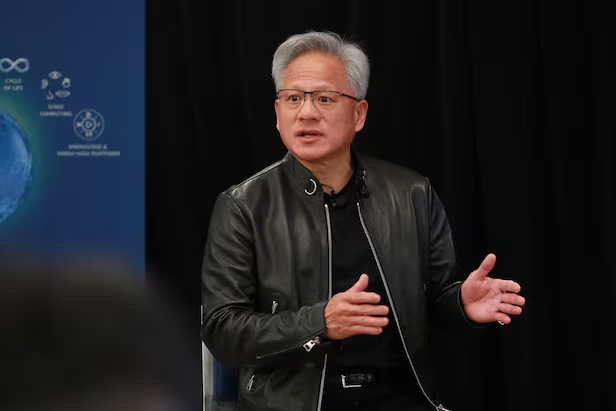
In a compelling discussion at the World Economic Forum in Davos, Jensen Huang, the innovative CEO and co-founder of NVIDIA, addressed one of the biggest fears of our time: the impact of artificial intelligence on jobs. Speaking on stage in his iconic leather jacket, Huang offered a refreshing perspective that calms anxieties while encouraging deeper self-reflection.
He explained that most people worry about AI replacing them because they confuse everyday tasks with their true purpose. “If you just watched us,” he said, gesturing to himself and the moderator, “you would probably think the two of us are typists because I spend all of my time typing.” But automating typing with AI wouldn’t eliminate a CEO’s role, it would simply free up more time to lead.
Huang’s insight, shared during the 2026 annual meeting, goes beyond technology. It provides a simple framework for anyone feeling uncertain about the future: separate the routine tasks of your work (or life) from the deeper purpose behind them. AI excels at handling repetitive tasks, but it amplifies human intent, creativity, and connection. This message offers hope in an era of rapid change, reminding us that technology can liberate us to focus on what truly matters.
Also in Explained | Why Did SpaceX Acquire xAI in a $1.25 Trillion Deal and What’s the Real Business Strategy Behind It?
Understanding the Task vs. Purpose Framework
Huang’s core idea is straightforward.. every job has tasks (the “how”) and a purpose (the “why”). Tasks are the mechanical parts typing emails, analyzing data, processing images, or even scheduling appointments that AI can automate efficiently. Purpose, however, is the human element: leading teams, caring for patients, solving complex problems, or innovating for the greater good.
Take Huang’s CEO example. A leader might spend hours drafting emails or reports, but that’s not the essence of the role. The purpose is strategy, inspiration, and decision-making. When AI handles the typing or data crunching, leaders gain time for higher-impact work. Huang extended this to healthcare: radiologists don’t just interpret scans (a task AI can assist with); their purpose is caring for people, which AI enhances by speeding up diagnostics and reducing wait times.
This distinction isn’t just for executives or professionals in tech-heavy fields. It applies to teachers (purpose: inspiring learning, not just grading papers), drivers (purpose: safe transportation, enhanced by autonomous aids), or customer service reps (purpose: solving problems and building trust, not rote responses). Huang’s framework shifts the conversation from fear of replacement to opportunity for elevation. AI doesn’t erase jobs; it evolves them, allowing people to dedicate energy to meaningful contributions.
For everyday individuals not just in corporate settings this mindset reduces stress. In personal life, think of household chores: automating laundry or grocery planning with smart tools doesn’t diminish your role as a parent or partner; it gives more time for relationships and personal growth.
Why This Matters in an AI-Driven World
Many fear AI because headlines focus on job displacement. Yet Huang, leading a company at the forefront of AI innovation, sees it as a tool for augmentation. NVIDIA’s technology powers much of the AI revolution, but Huang emphasizes human purpose remains irreplaceable. “The easiest way to think about the impact of AI on a particular job,” he noted, “is to understand whether the job.. what is the purpose of the job and what is the task of the job?”
This optimism is grounded in history. Past technologies like computers or the internet automated tasks but created new opportunities and industries. AI follows suit, potentially boosting productivity and solving global challenges, from healthcare delays to manufacturing inefficiencies. For workers, adapting means upskilling in areas AI can’t replicate: empathy, critical thinking, creativity, and ethical judgment.
On a personal level, Huang’s words encourage introspection. Are you defining your worth by a checklist of tasks, or by the impact you make? In relationships, hobbies, or community involvement, focusing on purpose brings fulfillment. Parents might automate meal prep to spend more quality time with children. Artists could use AI tools for tedious edits, freeing creativity. This approach turns AI anxiety into empowerment, helping people navigate change with confidence.
Psychological benefits abound too. Studies on automation show that reframing technology as a helper rather than a threat reduces stress and increases adaptability. Huang’s view promotes a growth mindset: embrace AI to enhance your unique human strengths.
Embracing AI for a More Purposeful Life
Huang’s Davos remarks challenge us to rethink our relationship with work and technology. Instead of resisting AI, welcome it as a partner that handles the mundane, unlocking potential for deeper purpose. Whether you’re a student, professional, parent, or retiree, this shift applies universally.
In uncertain times, with AI advancing rapidly, Huang’s advice offers reassurance: your value isn’t in repetitive tasks but in your intent, care, and vision. Companies may evolve roles, but individuals who focus on purpose will thrive. Governments and educators can support this by prioritizing training in human-centric skills.
Ultimately, Jensen Huang isn’t downplaying disruptions transitions can be challenging but he’s highlighting the upside. AI can free humanity from drudgery, allowing more time for innovation, connection, and meaning. By distinguishing tasks from purpose, we not only secure our livelihoods but enrich our lives.
In a world buzzing with AI hype and fear, Huang’s calm wisdom stands out: Technology serves us, not the other way around. Embrace the change, rediscover your purpose, and let AI amplify what makes you irreplaceable.
Also in Explained | Why Did Apple Choose Google Over OpenAI for Siri’s Massive AI Upgrade?