Summary:
- Tariffs on EU wines will drop from 150% to 20–30% (with some sources noting phased cuts to 20% for premium varieties), spirits to around 40%, and beer to 50%.
- The India-EU Free Trade Agreement Impact on Sri Lanka
- Whether Sri Lanka’s apparel industry, a cornerstone of its economy and a major EU exporter will face any risks?
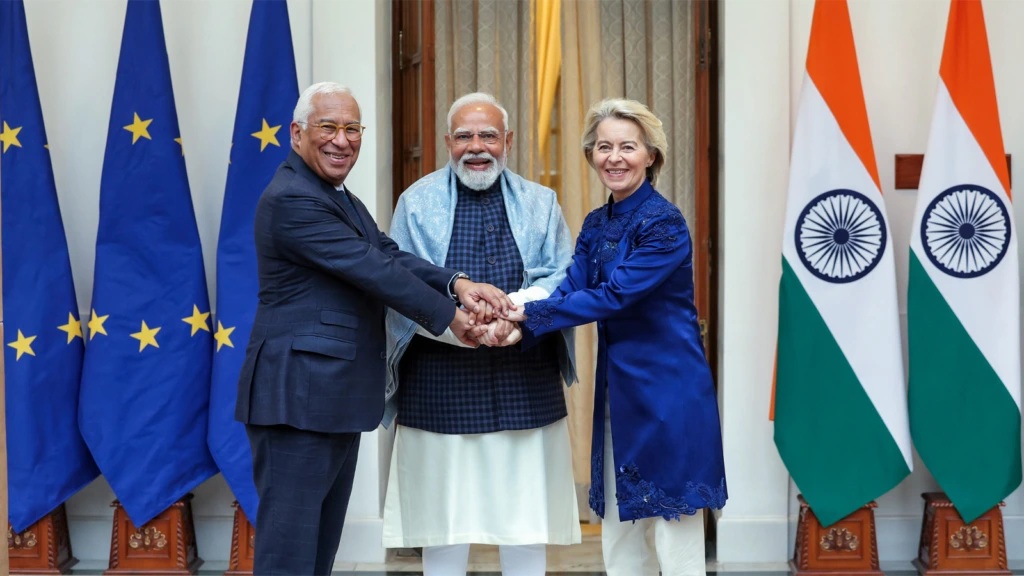
On January 27, 2026, India and the European Union (EU) officially concluded negotiations on a landmark Free Trade Agreement (FTA), hailed by leaders as the “mother of all deals.” Announced during the 16th India-EU Summit in New Delhi, the pact marks the end of nearly 20 years of intermittent talks and creates one of the world’s largest integrated markets, covering roughly 2 billion people and representing about 25% of global GDP.
The agreement, described by European Commission President Ursula von der Leyen and Indian Prime Minister Narendra Modi as a blueprint for shared prosperity, focuses on eliminating or significantly reducing tariffs on the vast majority of traded goods. According to official statements from the EU and India’s commerce ministry, tariffs will be eliminated or reduced on approximately 96.6% of EU goods exports to India by value, with phased implementation. In return, the EU will provide preferential access for nearly 99% of India’s exports by trade value, including immediate zero-duty access for many categories.
Key provisions include:
- India will gradually reduce tariffs on EU cars from as high as 110% to 10% over a period of 5–10 years, with quotas for certain volumes.
- Tariffs on EU wines will drop from 150% to 20–30% (with some sources noting phased cuts to 20% for premium varieties), spirits to around 40%, and beer to 50%.
- Duties on EU olive oil, processed foods (such as pasta and chocolate), machinery, chemicals, and pharmaceuticals will be eliminated or sharply lowered, often immediately or within short transition periods.
- For Indian exports, tariffs on textiles, apparel, leather, footwear, gems and jewelry, marine products, chemicals, plastics, base metals, and handicrafts will be cut to 0% in the EU market.
- Sensitive sectors remain protected: India excludes dairy, cereals, poultry, and certain agricultural items, while the EU maintains safeguards on items like sugar, meat, and beef.
Also in Explained | Sri Lanka’s FDI Milestone: Urgent Call for Structural Reforms to Sustain Momentum
The deal is expected to double EU goods exports to India by 2032, saving European exporters up to €4 billion annually in duties. Bilateral merchandise trade, valued at around $136–140 billion in recent years, is projected to grow substantially, with services and investment ties also strengthened. Additional pacts on security, defense, mobility for professionals, and clean energy were signed alongside the FTA.
This historic accord arrives amid heightened global trade tensions, particularly U.S. tariffs under President Donald Trump targeting both India and the EU. Leaders from both sides have framed the agreement as a strategic move to diversify away from over-reliance on any single partner, promote rules-based trade, and build resilient supply chains. It complements India’s existing deals with the UK and EFTA nations, while offering the EU a counterbalance to geopolitical uncertainties.
On a global scale, the FTA signals a shift toward deeper South-North economic integration. It could accelerate de-risking from concentrated manufacturing hubs, boost investment in technology and green sectors, and support job creation potentially millions in labor-intensive industries like textiles and apparel. Equity markets reacted positively in some segments, though certain Indian sectors (like domestic automakers) saw short-term pressure from increased competition. The pact may also influence commodity flows, as lower barriers encourage more efficient trade in metals, chemicals, and energy-related goods.
The India-EU Free Trade Agreement Impact on Sri Lanka
For neighboring countries like Sri Lanka, the implications are nuanced and largely indirect. Sri Lanka maintains its own trade frameworks with both India and the EU, but the India-EU FTA could reshape regional dynamics.
Sri Lanka benefits from duty-free access to the EU under the Everything But Arms (EBA) scheme for least-developed countries, particularly for apparel, tea, rubber, and spices. However, as India gains similar or enhanced zero-duty access for textiles, leather, gems, jewelry, and marine products sectors where Sri Lanka competes the competitive edge could narrow. Indian exporters, backed by larger scale, lower production costs in some areas, and improved supply-chain integration with Europe, may capture more market share, potentially pressuring Sri Lankan garment and tea exports.
Sri Lanka’s apparel industry, a cornerstone of its economy and a major EU exporter, faces risks if Indian competition intensifies. The deal could spur some Sri Lankan firms to seek joint ventures or partnerships with Indian counterparts to leverage the new access. On the positive side, lower EU tariffs on Indian-origin chemicals, metals, and machinery might indirectly reduce input costs for Sri Lankan manufacturers if regional supply chains adapt.
Trade with India itself could see mixed effects. Sri Lanka already enjoys preferential terms under the Indo-Sri Lanka FTA, but enhanced India-EU ties might divert some investment or sourcing toward India. Sri Lankan consumers could gain from cheaper EU imports transiting or competing via Indian channels, though direct benefits depend on local implementation.
Sri Lanka’s broader economy still recovering from recent challenges stands to gain if the deal stabilizes global trade and reduces fragmentation. Stronger India-EU links could support regional growth in South Asia through spillover effects, such as increased demand for services or tourism. Policymakers in Colombo may need to accelerate diversification, enhance productivity in key sectors like apparel, and explore deeper ties with the EU to maintain advantages.
The India-EU FTA remains subject to final legal scrubbing, parliamentary ratification (particularly in the EU), and potential implementation in late 2026 or early 2027. Its full impact will unfold over years, but it represents a pivotal moment in reshaping global commerce amid uncertainty.
For Sri Lankan businesses, the message is clear: monitor developments closely, adapt supply chains, and pursue strategic partnerships to navigate this evolving landscape.
Also in Explained | Sri Lanka Targets Stronger Economic Partnership with Saudi Arabia in Key Growth Sectors