
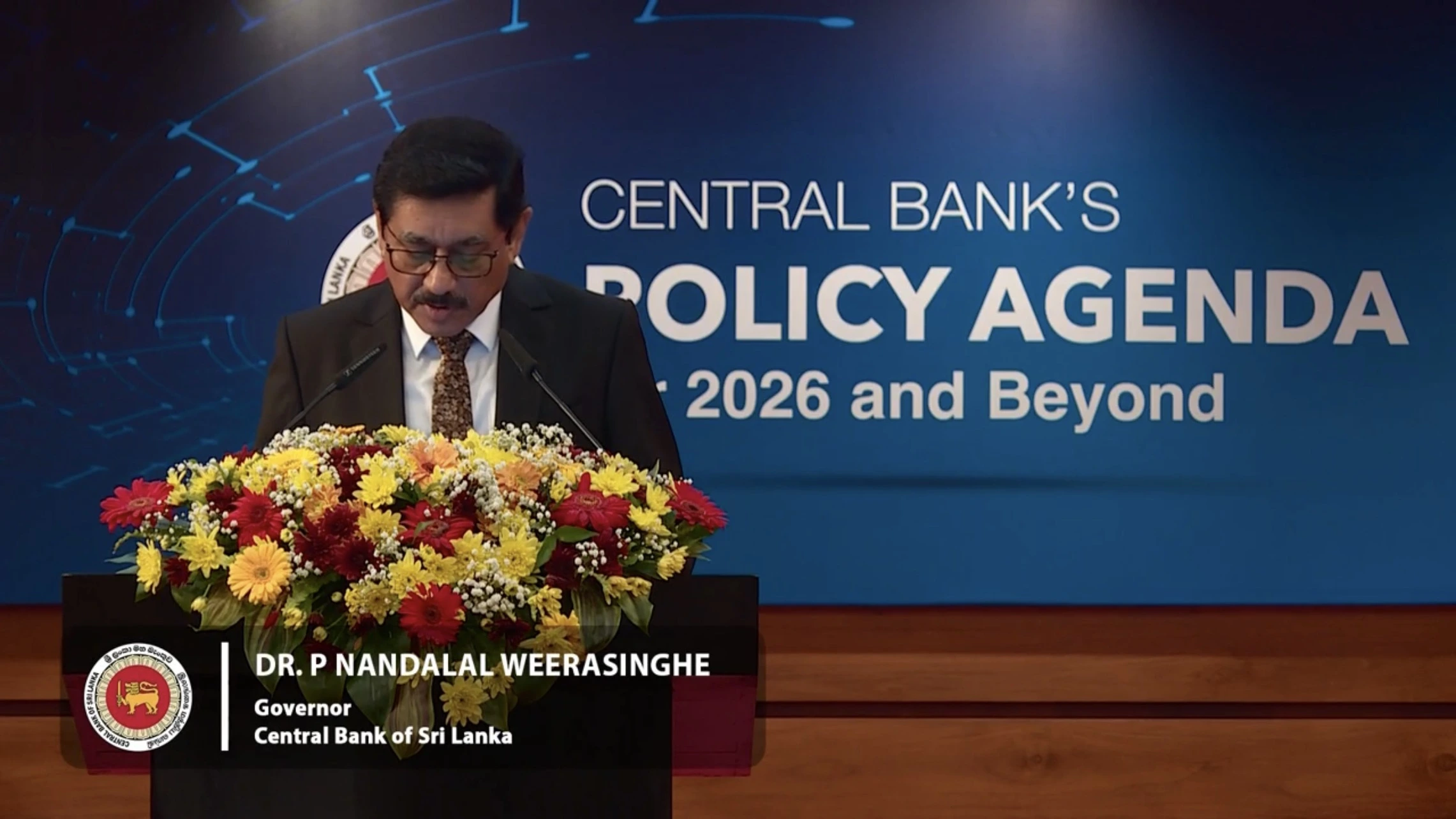
The Central Bank of Sri Lanka (CBSL) unveiled its Policy Agenda for 2026 and Beyond on January 8, 2026, setting a forward-looking framework that prioritizes macroeconomic stability to support private sector growth and market resilience. Amid a recovering economy that showed notable progress in 2025 despite global uncertainties and the devastating Cyclone Ditwah, the agenda offers businesses clear signals for planning investments, managing costs, and navigating external pressures.
Accommodative Monetary Policy and Private Sector Credit Expansion
The CBSL’s flexible inflation targeting framework, anchored at a 5 percent target agreed with the government, continues to guide policy with strong emphasis on transparency and accountability. In 2025, the bank eased its accommodative stance further, resulting in lower market interest rates and significant private sector credit growth that was broad-based across sectors, including a sharp rise in household lending driven by improving demand. This helped sustain economic momentum even as global trade policy shifts, financial market volatility, and geopolitical tensions weighed on sentiment.
For 2026, the CBSL projects inflation to rise gradually toward the 5 percent target by the second half of the year, supported by ongoing growth of around 4-5 percent. While Cyclone Ditwah introduced both downside risks (supply chain damage) and upside potential (reconstruction spending), strengthened buffers in fiscal, external, and monetary sectors position the economy for quicker recovery than in past crises. Businesses can expect continued policy support for credit access, as the bank refines data-driven decision-making through improved modeling of post-crisis dynamics and incorporation of high-frequency granular data for real-time surveillance.
The planned review of the inflation target agreement, including stakeholder consultations, will ensure the framework remains responsive to structural changes and potential supply shocks, helping anchor long-term inflation expectations and reduce uncertainty in corporate budgeting and pricing.
External Sector Strength and Foreign Exchange Market Enhancements
Sri Lanka’s external sector delivered a current account surplus for the third straight year in 2025, despite elevated vehicle imports and global pressures. Gross official reserves rose above US$6.8 billion by year-end, the highest post-crisis level bolstered by US$2.0 billion in net foreign exchange purchases by the CBSL. The market-determined exchange rate remained relatively stable with only gradual depreciation, demonstrating effective management of liquidity and volatility.
In 2026, key reforms will directly benefit businesses reliant on trade and foreign currency transactions. The introduction of a benchmark intra-day reference exchange rate will enhance transparency, curb volatility, and encourage competitive pricing while enabling innovative FX products. Updating base years for the Nominal Effective Exchange Rate (NEER) and Real Effective Exchange Rate (REER) indices will provide more accurate measures of trade competitiveness following the full removal of import restrictions. Reserve management will adhere to principles of safety, liquidity, and return, with the newly created investment tranche allowing optimized yields in favorable conditions, the first such move in four years.
These measures, combined with the CBSL’s commitment to building reserves through market purchases while preserving exchange rate flexibility, should ease hedging costs and improve liquidity for importers, exporters, and investors.
Operational Refinements and Coordinated Policy Framework
The single policy rate mechanism, centered on the Overnight Policy Rate (OPR), will see targeted liquidity management to correct late-2025 deviations in short-term rates caused by uneven liquidity distribution and credit pickup. Statutory Reserve Ratio (SRR) optimizations, including redefined reserve maintenance periods, phased elimination of till-cash concessions, and higher daily minimum requirements will align with international best practices and potentially unlock additional lending capacity.
Enhanced communication focusing on accessibility and inclusivity, along with the published 2026 monetary policy advance release calendar, will improve predictability for market participants. Government fiscal consolidation complements these efforts, while coordination platforms like the Coordination Council ensure aligned responses to emerging risks. As public debt management transitions to the Ministry of Finance, the CBSL retains oversight of securities systems and primary dealers, maintaining smooth market operations.
Overall, the agenda creates a stable platform for business expansion, emphasizing resilience against shocks and sustained private sector-led growth.
Sources: Data was obtained from the Central Bank of Sri Lanka (CBSL)
Also in Explained | Sri Lanka’s Banking Sector Demonstrates Resilience in Q3 2025 Financial Soundness Indicators