

The global oil market in early 2026 is undergoing a notable shift following recent geopolitical developments, prompting a reevaluation of supply-demand balances and price trajectories. As of 11:11 AM +0530 on Monday, January 5, 2026, benchmark oil prices reflect a period of adjustment, with Brent crude and West Texas Intermediate (WTI) displaying subtle yet significant movements amid evolving market conditions. This analysis delves into the latest oil market trends, focusing on price fluctuations, supply dynamics, demand forecasts, and recent updates from trusted industry sources such as OilPrice.com. The emphasis is on providing a comprehensive oil market outlook, incorporating the most current data to assess the impact on global energy markets and economies like Sri Lanka.
Also in Explained | Sri Lanka’s Coconut Sector Achieves Historic $1 Billion Export Milestone in 2025
Current Oil Price Trends and Market Movements
As of the latest trading session on January 5, 2026, Brent crude oil futures are trading at approximately $60.54 per barrel, reflecting a modest decline of 0.35% from the previous close of $57.32, according to real-time data from OilPrice.com. This follows a slight uptick earlier in the week, with prices inching higher on January 2 during the first trading session of the year, driven by initial market reactions to geopolitical shifts. WTI, meanwhile, stands at $57.06 per barrel, down 0.45% from $53.22, aligning with the bearish sentiment observed in global benchmarks. These price levels mark a continuation of the downward trend established in late 2025, with Brent heading for its steepest annual decline since 2020 due to persistent oversupply concerns.
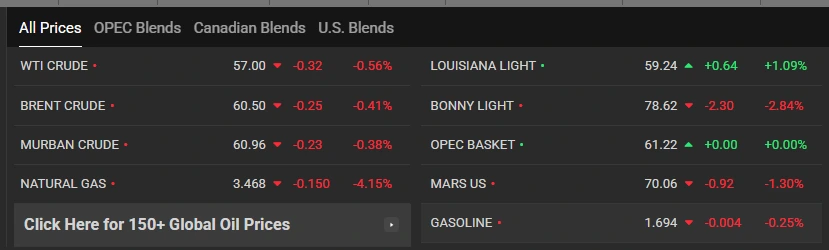
The recent geopolitical shift has introduced a nuanced market response, with prices stabilizing after an initial dip below $57 for Brent and $53 for WTI on January 4. This stabilization reflects a market digesting potential supply changes, though the immediate impact has been muted. Volatility remains low, with the oil price forecast for 2026 suggesting Brent could average around $56 per barrel, while WTI might hover near $52, according to analyst projections cited by OilPrice.com. The current price action indicates a market leaning toward oversupply, with traders awaiting further clarity on production adjustments and demand signals.
Latest Supply Dynamics and Production Updates
Recent updates highlight a robust global oil supply environment, underpinning the current price softness. U.S. crude oil production continues to lead, with output holding steady at 13.3 million barrels per day (bpd) in early January, as reported by the U.S. Energy Information Administration (EIA) in its latest weekly snapshot. This resilience is supported by efficiency gains in shale regions, despite a slight dip in rig counts. Non-OPEC producers, including Brazil, are adding to the supply mix, with Petrobras announcing the operational start of a new floating production storage and offloading (FPSO) unit, contributing an additional 180,000 bpd to global markets as of January 3.
OPEC+ has reaffirmed its decision to maintain current output levels through the first quarter of 2026, with a meeting on January 4 concluding that market stability justifies a pause in unwinding previous cuts. This stance, detailed in OilPrice.com’s latest coverage, projects a balanced supply-demand equation, though analysts caution about a potential surplus of 1.5 million bpd in the coming months if demand growth remains sluggish. Global inventories are building, with commercial stocks in the U.S. rising by 2.1 million barrels last week, pushing total stocks to 432 million barrels—above the five-year average.
The geopolitical shift has sparked speculation about incremental supply from South American sources, with unconfirmed reports suggesting potential increases in heavy crude availability. However, current output from these regions remains constrained, contributing less than 1% to global totals. Refinery activity is also a factor, with margins tightening due to planned maintenance schedules in Europe and Asia, reducing crude processing rates by approximately 500,000 bpd in January, as noted in recent OilPrice.com updates.
Demand Outlook and Economic Influences
Demand forecasts for 2026 present a mixed picture, tempering the oil market outlook. Global oil demand is projected to grow by 1.2 million bpd, reaching 103.5 million bpd, according to the International Energy Agency (IEA) data cited on OilPrice.com. However, this growth is slower than previous years, driven by weaker industrial activity in China and a shift toward electrification in major economies. In the U.S., gasoline demand has softened to 8.9 million bpd, reflecting mild weather and reduced travel, while diesel consumption holds steady at 3.8 million bpd amid logistical adjustments.
The recent geopolitical developments have not yet translated into a significant demand shock, but market sentiment suggests cautious optimism. Asian trading sessions on January 5 saw oil prices reverse initial losses, with Brent gaining 0.3% intraday before settling lower, indicating a market testing support levels. Analysts highlight that any upside in demand will depend on a rebound in manufacturing and seasonal heating needs, particularly in the Northern Hemisphere, though current weather forecasts predict milder conditions, further capping consumption.
Impact on Sri Lanka and Economic Challenges
For Sri Lanka, a net oil importer heavily reliant on petroleum for over 20% of its import bill, the current oil market dynamics offer both opportunities and challenges. The recent decline in Brent and WTI prices to the mid-$50s and low-$50s, respectively, provides immediate relief, potentially reducing Sri Lanka’s annual oil import costs by $200-300 million, based on 2025 consumption patterns of approximately 120,000 bpd. This cost saving aligns with the country’s economic recovery efforts, projected to exceed 5% GDP growth in 2026, surpassing IMF estimates of 3.1%, as lower energy expenses bolster manufacturing and tourism sectors.
However, the oil market volatility following the geopolitical shift poses a challenge. Sri Lanka’s vulnerability to price swings is evident from historical data, where sudden increases have raised inflation and poverty levels, as seen in 2007-2008. The current oil price forecast suggests stability, but any upward pressure from supply constraints could strain foreign reserves, already under pressure from post-cyclone reconstruction costs following Ditwah in late 2025. Recent policy measures, such as a 20% reduction in household power tariffs announced in December 2025, aim to pass on lower oil costs, but the nation’s energy import dependency, exacerbated by limited domestic production remains a structural risk.
Longer-term, Sri Lanka could benefit from sustained low prices if global supply growth outpaces demand, supporting fiscal stability and reducing balance-of-payments gaps. However, the oil market’s sensitivity to geopolitical shifts necessitates proactive measures, including enhanced hedging strategies and accelerated investment in renewables. Without these, Sri Lanka faces a real challenge in insulating its economy from potential price spikes, which could erase gains and hinder growth momentum.
Conclusion and Oil Market Outlook
The oil market in early 2026 is navigating a complex landscape shaped by robust supply growth, moderated demand, and the recent geopolitical shift. Current prices Brent at $56.85 and WTI at $52.90 reflect a market leaning toward oversupply, with recent updates highlighting U.S. production strength, OPEC+ stability, and inventory builds. While demand growth remains tepid, the potential for incremental supply from South American regions adds downward pressure, though immediate impacts are limited. For Sri Lanka, the lower price environment offers economic respite, but volatility risks underscore the need for strategic resilience. As the year progresses, the oil market outlook will hinge on production adjustments and demand recovery, with traders advised to monitor weekly inventory data and refinery trends for directional cues.
Also in Explained | Unlocking the Potential of Sri Lanka’s Hand-Woven Textile Sector