
Elon Musk, the visionary behind Tesla, SpaceX, and xAI, has once again sparked global discussion on the future of energy and artificial intelligence. In a recent clip from the 2025 US-Saudi Investment Forum, shared widely on X (formerly Twitter), Musk argued that deploying AI computing systems in space, powered directly by solar energy is not just feasible, but inevitable for humanity’s long-term progress.
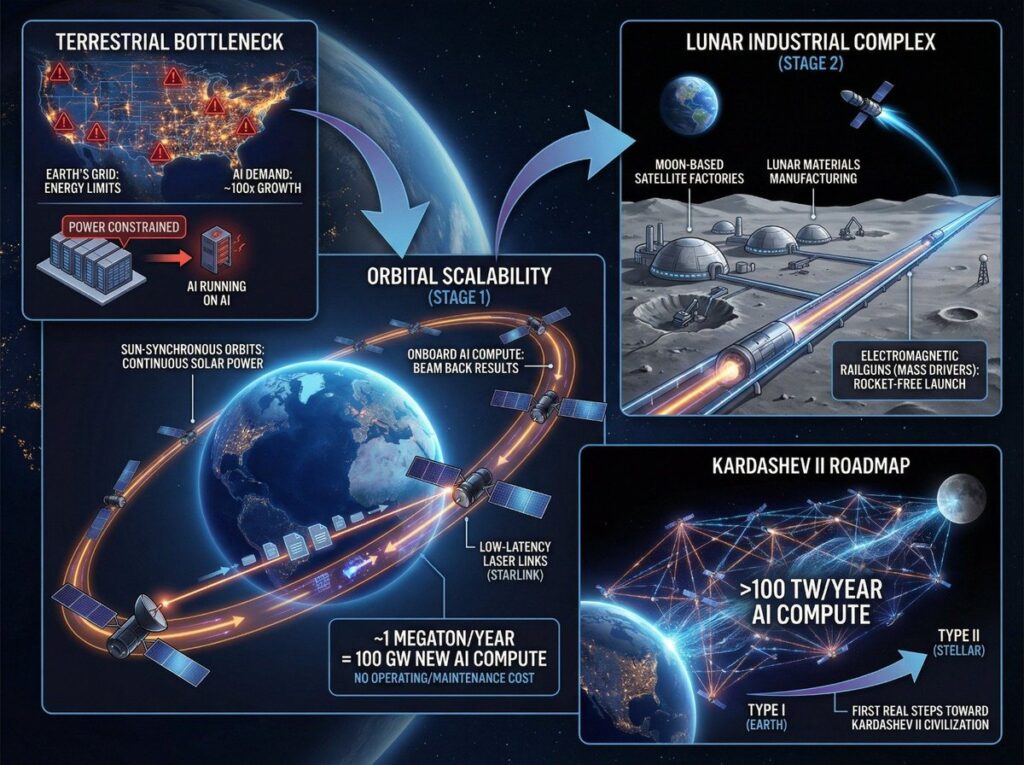
“If civilization continues, AI in space is inevitable,” Musk stated. “In order to achieve any meaningful percentage of a Kardashev II-scale civilization, where you’re using even a millionth of the Sun’s energy you must have solar-powered AI satellites in deep space.”
The Kardashev Scale
A framework proposed by Soviet astronomer Nikolai Kardashev in 1964, measures a civilization’s technological advancement by its energy consumption. A Type II civilization harnesses the full energy output of its star (in our case, the Sun), far surpassing today’s human society, which is still below Type I (planetary-scale energy use).
Musk’s key points highlight why space offers unparalleled advantages for AI data centers:
- Constant Solar Power: In orbit, satellites receive uninterrupted sunlight, eliminating the need for batteries. Earth-based solar panels capture energy only during daylight, but space systems could operate 24/7.
- Cost Savings: Solar panels in space don’t require protective glass or heavy framing, reducing manufacturing and launch costs.
- Superior Cooling: Radiative cooling in the vacuum of space is far more efficient than Earth-based systems, which rely on fans, water, or air conditioning – a major expense for massive AI clusters.
- Timeline: Musk predicts that within 4-5 years, space-based AI compute will be cheaper than ground-based alternatives.
He emphasized that Earth’s energy infrastructure cannot scale to meet AI’s explosive demands. Current US average power consumption hovers around 500 GW, but terawatt-scale AI training and inference could overwhelm grids. Space sidesteps these limits by tapping directly into the Sun’s vast output – Earth receives only a tiny fraction (about 1/2 billionth) of the Sun’s total energy.
Musk’s comments align with broader industry trends
Competitors like Jeff Bezos’ Blue Origin and startups such as Aetherflux are exploring orbital data centers. Google and others have prototyped solar-powered satellites for AI chips. As of late 2025, demonstrations like Caltech’s Space Solar Power Demonstrator have successfully beamed power from orbit to Earth, proving key technologies.
For businesses and economies, this could revolutionize energy-intensive sectors. Unlimited, low-cost compute in space might accelerate AI breakthroughs in healthcare, finance, and manufacturing, while reducing reliance on strained terrestrial grids.
In Sri Lanka and emerging markets, where energy access and reliability remain challenges, space-based solutions could leapfrog traditional infrastructure. Imagine AI-driven innovations powered by abundant orbital energy, fostering growth without the environmental footprint of fossil fuels.
Musk concluded the clip by noting the “overwhelmingly better” cost-effectiveness of space AI, calling it “so obvious.” As SpaceX’s Starship ramps up launches, this sci-fi vision edges closer to reality – potentially propelling humanity toward a true multiplanetary, energy-abundant future.
What do you think? Could space-based AI transform global business and energy markets? Share your views in the comments.
Lanka Biz News – Covering innovation, technology, and business opportunities in Sri Lanka and beyond.
Also in Explained | SpaceX’s $1 Trillion IPO: How Orbital AI Infrastructure Could Reshape Global Computing in 2026